




Background Investigators Don’t Read Applications. They Read Omissions.
Ask any background investigator what ends more law enforcement candidacies than actual misconduct, and the answer is consistent: the thing the candidate didn’t write down. A dismissed at-will job from eight years ago, quietly omitted. An address from a difficult year, left off the timeline. The recurring marijuana-era charge the candidate assumed was spent. The record showed everything — and the gap in the candidate’s own account ended the process, because in policing, the omission is the disqualifier.
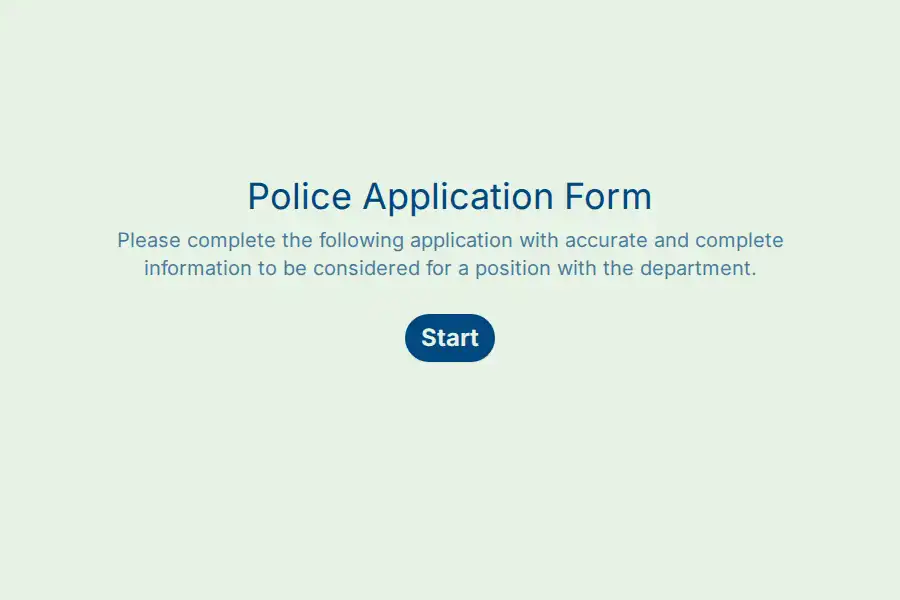
This police application form template is built around that single truth: its job is to make honesty the path of least resistance. It collects the personal history statement — the investigator’s starting file — in a structure that explains, at every step, why completeness beats polish.
The Unbroken Chronology
The core of any personal history statement is continuity: a ten-year record of residence, employment, and education in which every month is accounted for. The form collects it as structured entries — addresses through the address field, employment and study periods with start and end date fields — with the instruction stated inside the flow itself: account for every month, including gaps, and explain what you were doing during them. Unemployment, travel, caregiving: all legitimate, all expected on the record, and all better declared than discovered.
Disclosures, Framed for Truthfulness
The disclosure sections carry a message most applications never deliver: disclosed matters are evaluated on context, timing, and relevance; undisclosed matters end candidacies. An opinion scale or plainly worded yes or no questions open each disclosure area — arrests and charges, driving record, substance use history, financial standing — with long text fields for the account behind each yes. Candidates who read ‘explain the circumstances; age and context are considered’ write more complete histories than candidates who read a bare checkbox wall. That sentence is the form’s most important piece of copy.
References Who Have Actually Known You
Background investigations interview people, and the quality of the starting list determines the quality of the investigation. The reference block asks for each referee’s relationship and how long they’ve known you — a number field — because five-year friends, former supervisors, and long-term neighbors carry evidentiary weight that recent acquaintances cannot. Collecting the depth requirement at entry saves investigators a round of replacements.
Documents and the Certification That Matters
Military service records, certifications, and supporting documents arrive through file upload, filed with the statement they support. Then the closing instrument: a legal field in which the applicant certifies the statement is true and complete, with the jurisdiction’s own consequence stated plainly — in most agencies, falsification of this document is itself the disqualifying offense. Candidates who understand that sign it more carefully.
Built for a Form Nobody Fills In One Sitting
A personal history statement takes an evening or three, which shapes the design: partial submissions preserve a candidate’s progress when life interrupts — investigators see enough half-finished attempts to know this feature decides completion rates — and a progress bar makes the length feel structured rather than punitive. Each finished statement can trigger an automated confirmation email giving the candidate a dated record of what they submitted. Access stays with the people the statement exists for: role-based permissions confine the file to background investigators, viewer seats let command staff review status without touching contents, and agency-hosted domains keep the candidate’s first impression official. Adjacent screening and hiring intake lives in the application templates, the employment collection, and the broader recruit talent library.
Frequently Asked Questions
What is a personal history statement?
The foundational document of a law enforcement background investigation: an unbroken account of the applicant’s residence, employment, education, and disclosures across roughly ten years, plus references and supporting documents — the file the investigator works from before a single interview is conducted.
How far back should the record go?
Ten years is the common investigative standard, and the form should ask for every month of it. The ‘unbroken’ requirement matters more than the number: a candidate who accounts for a six-month gap honestly is in a stronger position than one whose timeline quietly skips it.
How should the form treat minor or old disclosures?
Explicitly. State within the disclosure sections that matters are evaluated on context, severity, and time elapsed — because applicants who believe that write full histories, while applicants who fear a checkbox write filtered ones. The filtered history is what investigators actually disqualify.
Who can see a completed statement?
Background investigators only, with command staff on read-only status if needed. These files contain the most personal material any hiring process collects, and access control is part of the agency’s obligation — not an administrative nicety.
What if an applicant can't recall exact dates or addresses?
Instruct them to estimate and flag it: ‘approximately 2016–2017’ is an honest answer and investigators work with estimates routinely. What the record cannot survive is a blank where a hard memory should be — which is why the form asks for the explanation, not just the dates.