
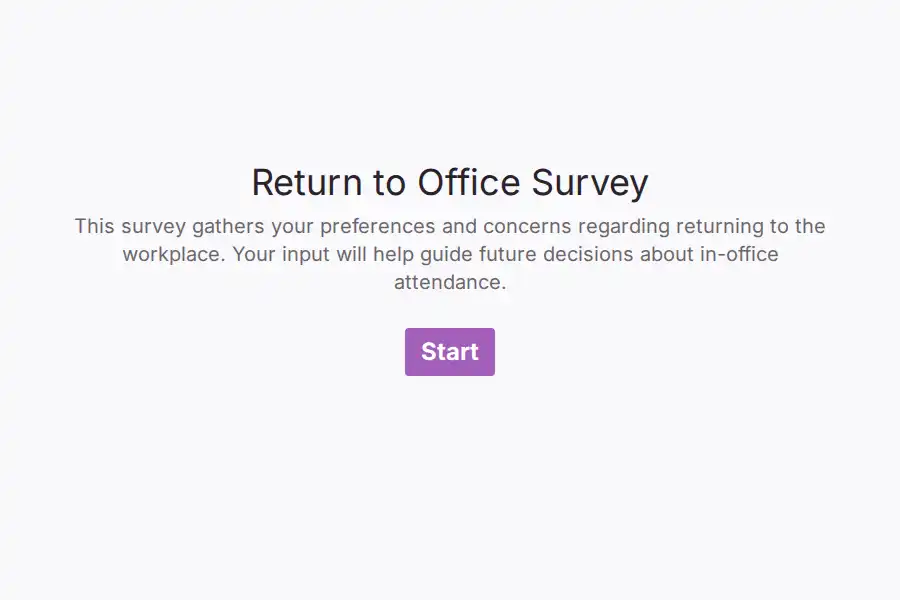

Return to Office Survey Template
Designing a return-to-office or hybrid work policy without consulting your team is a recipe for workplace friction. Blanket, top-down mandates that fail to consider commute times, caregiving responsibilities, and team focus needs often damage morale and can lead to valued team members seeking remote roles elsewhere.
This return-to-office survey template gives leadership teams a clear way to understand their workforce’s daily realities and workspace preferences. By capturing concrete details about hybrid schedule desires, commute times, in-office task alignment, and potential caregiving needs, you can construct a policy that respects employee wellbeing while supporting collaboration.
Workspace Factors Measured in this Survey
This survey focuses on the logistics, benefits, and concerns of returning to a physical workplace:
- Current Status & Desires: Evaluates their current work arrangement and uses dropdowns and multiple-choice questions to capture preferred office days per week and specific day selections.
- Perceived Advantages & Drawbacks: Employs long-text fields to collect qualitative opinions on the main benefits of returning to the office, as well as their biggest concerns.
- Commute Analysis: Utilizes a dropdown field to track typical one-way commute times, providing crucial context regarding regional differences.
- Contextual Details: Captures role or department groupings and features a yes/no question to assess if childcare or other caregiving responsibilities impact office availability.
- Resource Requirements: Collects open-text feedback on what resources, office upgrades, or support systems would make returning to the office easier for them.
How to Build a Supportable Hybrid Work Policy
- Tailor Policies by Role Type: Analyze the survey results by role and department. Process-oriented departments may succeed fully remote, while creative or client-facing teams might benefit from coordinated, shared office days.
- Mitigate Commute Friction: Review the commute time data. If a high percentage of your team has one-way commutes exceeding 45 minutes, consider offering core collaboration hours (e.g., 10 AM to 3 PM) to let employees avoid peak travel traffic.
- Prioritize In-Office Assets: Look at what resources employees request. If team members highlight focus as a main concern, invest in quiet work areas, phone booths, or collaboration technology rather than just rows of standard desks.
Frequently Asked Questions
How does this survey help prevent employee turnover during a policy transition?
By gathering employee input before finalizing your policy, you demonstrate that leadership values their team’s personal responsibilities and work styles. This collaborative approach dramatically reduces friction and helps you build a compromise that supports both company and employee goals.
Why does the survey ask about caregiving responsibilities?
Flexible work arrangements have allowed many employees to manage childcare or eldercare effectively. Understanding if caregiving challenges impact office availability helps you design policies with realistic expectations and sufficient support.
Can we run this return-to-office survey anonymously?
Yes. The template does not require identifying details like names or emails unless you choose to add them. Collecting anonymous responses encourages team members to be completely honest about their concerns, commutes, and caregiving needs.
How should we communicate the survey results to our team?
Share a high-level summary of the findings—such as average preferred office days and top concerns—alongside your policy announcement. Explaining how employee feedback directly shaped your hybrid policy builds trust and encourages policy compliance.