
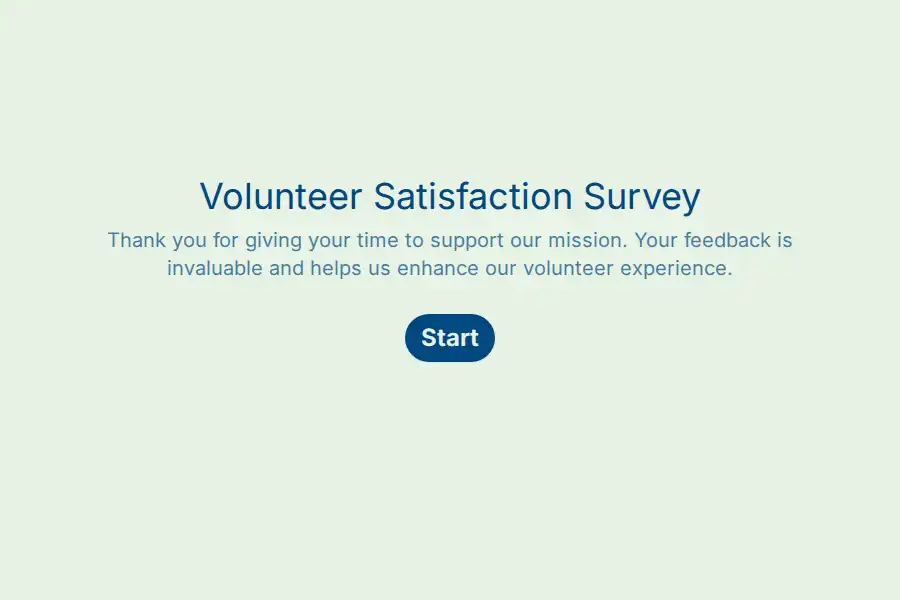
Volunteer Satisfaction Survey
Volunteers almost never announce they are leaving. The pattern is quieter: a missed shift, then another, then a busy lately that never quite resolves — and by the time anyone asks, the relationship has been cold for months. This satisfaction survey is the early-warning system your program needs. Run it periodically, read it honestly, and the drift becomes visible while it is still reversible.
The Quiet Exit Problem
Losing a volunteer is expensive in ways that never appear on a budget line. Experienced helpers carry institutional knowledge no induction can transfer quickly; long-tenured volunteers anchor the culture every newcomer absorbs. And because they leave without complaint, programs routinely misread attrition as life happening — when a handful of fixable frictions were the actual cause. Measuring the relationship directly is the only reliable way to tell the difference.
Four Signals Worth Measuring
The survey balances a single completion sitting with the four indicators that matter:
- Overall satisfaction — an opinion scale question, simple and trendable across quarters
- Support from coordinators — a rating question about briefings, responsiveness, and feeling looked after; low scores here predict exits months ahead
- Belief that the time mattered — a yes/no on whether volunteering felt meaningful, with room to explain. Volunteers who stop believing their effort counts are already halfway out the door
- Loyalty signals — a recommendation question (would you suggest volunteering with us to a friend?) plus willingness to continue. Together they separate your promoters from your quietly departing
Anonymity Is the Feature, Not a Flaw
Ask volunteers to critique their coordinators by name attached and you will receive flattery. The survey’s value lives in psychological safety: the name field stays optional, the introduction says plainly that candor is wanted and consequence-free. You sacrifice follow-up on some responses; you gain the truth — and patterns in aggregate tell you more than any single named complaint would.
From Scores to Save Actions
A score only matters if it triggers something:
- Low support ratings → invest in coordinator coaching and clearer communication rhythms before the next cycle
- Impact skepticism → start sharing outcomes and stories with the team; people stay for visible results, not gratitude alone
- Promoters → invite them upward: mentoring, committee seats, lead roles
- Identified detractors → a personal, non-defensive call. One honest conversation routinely reverses an exit
Turn satisfaction responses into a trackable score so movement between quarters is visible at a glance — and browse the wider satisfaction survey library for adjacent audiences.
Frequently Asked Questions
How often should we measure volunteer satisfaction?
Quarterly for ongoing programs, once at the end for cohort or seasonal ones. More frequent pulse-taking breeds fatigue; less than twice a year and drift hides between measurements. Pick a cadence, keep it consistent, and compare like with like.
What is a healthy satisfaction score?
There is no universal number — programs, roles, and communities differ too much. What matters is the trend and the spread: rising scores with few bottom-scale answers signal health; a stable average hiding a growing cluster of low scores signals quiet churn. Trends tell the truth that absolutes flatter.
Should coordinators see individual responses about themselves?
Not directly. Route results to a coordinator’s manager or an oversight lead, and share patterns rather than verbatims attached to names. This protects the anonymity you promised — and protects coordinators from defensive spirals over a single harsh answer.
What if scores drop after a change we made?
Say so, out loud, to your volunteers: acknowledge the dip, explain the reasoning, and ask for specifics on what to adjust. Programs that acknowledge a self-inflicted dip typically recover trust faster than before the dip. Silence, by contrast, confirms every suspicion the low scores contained.
How is this different from an evaluation form?
The satisfaction survey checks the whole relationship — support, meaning, loyalty — at a program level, periodically. An evaluation form reviews a specific placement, project by project. Use evaluations to fix roles; use this to keep the relationship worth staying in.