
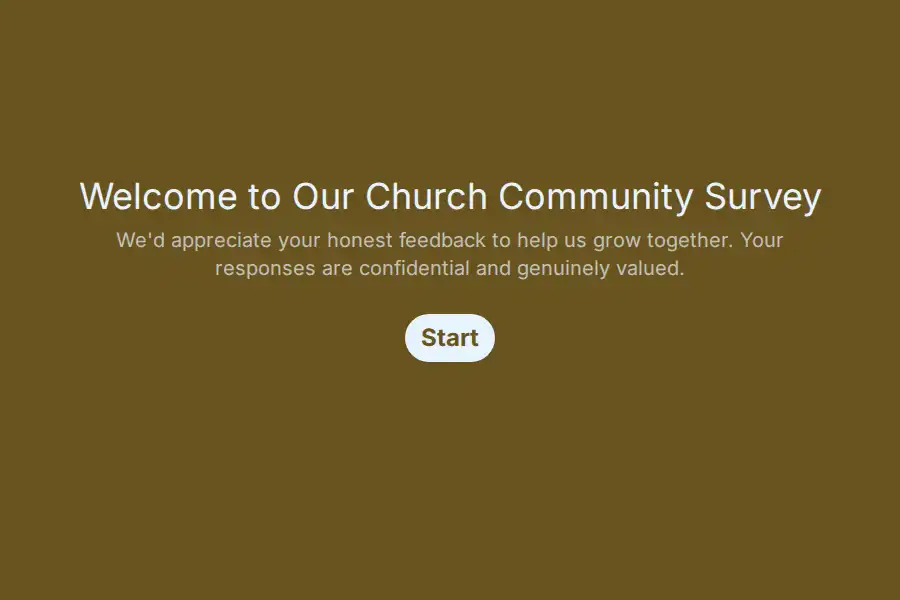
Church Survey Questions Template
Every congregation has two congregations: the members who find a leader after the service to share exactly what they think, and the quiet majority whose preferences never surface at all. Announcement-sheet feedback and pulpit polls amplify the first group and erase the second. A once-a-year listening survey gives everyone the same microphone — same questions, same link, same five minutes — and hands leadership something no amount of coffee-hour conversation can: a fair count.
This church survey template is that microphone, pre-built. The questions are drafted, the answer formats are chosen, and the whole set is tuned to be completed on a phone between the parking lot and the front door.
A Question Set Organized Around Four Listening Goals
Worship. Which service a member attends (multiple choice), followed by satisfaction ratings for the teaching and the music (rating questions). The attendance answer gives every other response its context — a complaint about evening service crowding reads very differently from one about the early service.
Belonging. A connection scale measures whether members feel known, a short text prompt asks what they value most about the church, and a recommendation question — would you invite a friend? — quietly measures pride in the community better than any direct question could.
Serving. A yes/no question asks whether the member currently serves, and interested members can leave their details in an optional contact block — turning the survey into a warm volunteer pipeline at no extra effort.
The open floor. One long text field invites anything the questions missed: ideas, concerns, encouragements. It is routinely the most-read answer in the whole survey.
Twelve questions, five minutes, and a progress bar showing exactly how little remains — short enough that finishing feels easier than quitting.
Distribution: Go Where the Congregation Already Is
The best question set fails if it lives only on a webpage nobody visits. Match the channels to the congregation:
- WhatsApp groups. In much of the world, the church WhatsApp group is the communication channel. Share the form link straight into it, where members already read everything.
- The church website. Embed the survey on the connected page so visitors and members find it without a link hunt.
- The bulletin and pulpit. A printed QR code plus one sentence from the front — “five minutes, this week only” — outperforms three weeks of subtle mention.
And respect real life: someone starts the survey after the service, a child needs collecting, the form closes mid-answer. Partial submissions keep the half-finished responses safe to complete later, which matters enormously when your audience is answering between commitments.
Close the Loop or Lose the Trust
Nothing suppresses next year’s participation like silence after this year’s. Three habits keep the goodwill compounding:
- Set the expectation at submission. The closing screen states when and how results will be shared — “watch for the summary in March’s newsletter” is enough.
- Work from one queue. Every response sits in the response list, and teams that prefer spreadsheets can pipe results out automatically via webhook for charting year over year.
- Report back visibly. Publish the headline findings and the two changes you’re making because of them. Members who see their anonymous suggestion become a new small group will fill in next year’s survey twice as fast.
An Annual Instrument, Not a One-Off
Trends matter more than snapshots, so run the identical questions each year: duplicate the form, rename it for the new year, and compare belonging scores and volunteer numbers against last year’s baseline. Between annual runs, lightweight poll templates handle quick pulse questions without the full survey. For deeper listening exercises, the feedback template collection and the satisfaction survey library cover the neighboring formats.
Frequently Asked Questions
How many questions should a church survey include?
Fewer than leaders want and more than members fear — about ten to twelve, completable in five minutes. Every question should be traceable to a decision: if the answer wouldn’t change a schedule, a budget line, or a program, it’s a poll question for another day, not part of the annual survey. Length discipline is what keeps completion rates high enough for the results to be representative.
How do we get members to answer honestly?
Say three things out loud before anyone clicks: answers can be given without a name, the results go to the leadership team and no one else, and a summary of findings will be published with the changes it prompts. Then keep all three promises. The published summary is the one leaders most often skip — and the one that most determines whether next year’s responses are candid or polite.
When is the best time of year to run it?
Avoid December and August, when attendance is erratic and attention is elsewhere. Late autumn works well for most churches — programs are in full swing, so opinions are informed — and early spring suits those planning budgets mid-year. Whatever you choose, hold the same month annually so year-over-year comparisons measure the congregation rather than the calendar.
Can the survey actually fill volunteer teams?
It reliably produces a warmer list than any announcement appeal: members who tick the serving question and leave contact details have already self-selected and expect a conversation. Route those names to the relevant ministry lead within a week while the intent is fresh. One caution — treat the survey as the discovery step, not the signup itself; a personal invitation remains what actually gets someone onto a rota.