
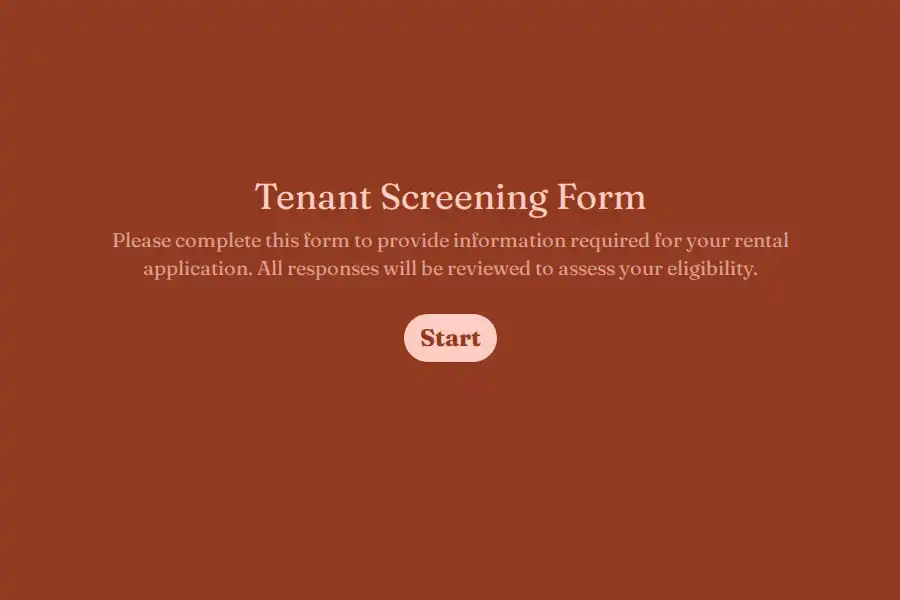
Tenant Screening Form Template
Most screening failures aren’t caused by bad information — they’re caused by improvised standards. One applicant is asked for three months of statements; the next gets a handshake and a move-in date. Beyond the obvious fairness problem, inconsistency carries real legal exposure: fair-housing and discrimination rules in many jurisdictions turn on whether similar applicants were treated similarly. A screening form does something subtler than collecting data — it forces the standard to be defined before anyone applies, and then applies it to everyone without exception.
Write the Criteria Before the First Application Arrives
Screening goes wrong when requirements are invented per applicant. So the working sequence is:
- Decide the factors — income threshold, rental history expectations, reference requirements, documentation list
- Write them down — the act of writing exposes the criteria that can’t be defended
- Check them against local law — some factors are restricted, some outright prohibited, and jurisdiction rules
- Only then, publish the form
From that moment, the form isn’t a questionnaire — it’s your standard, made executable.
The Declarations Section
Declarations create a uniform, comparable record — and put every applicant on equal notice about what will be verified:
- Previous evictions? — a yes/no question with a detail field, because context belongs on the record too
- Smoking, where the property’s policy restricts it
- Pets — declared uniformly, assessed against one written policy
- Court judgments or bankruptcies, where lawful to ask in your jurisdiction
The point isn’t tricking anyone. It’s that every applicant answers the same questions, in the same words, at the same stage — which is exactly what makes the resulting comparisons defensible.
The Evidence
Declarations are claims; evidence is what screening verifies:
- Income proof — payslips, contracts, or statements uploaded to the form
- Photographic identity
- Verifier contacts — previous landlord and employer, named and reachable
The form gathers and organizes. The verification itself — calls, document checks, any formal reporting — runs through your chosen process afterward. Nothing here automates a decision, and nothing should.
Authorization, Done Properly
Where your process includes credit or background reporting, authorization is its own explicit step: a dedicated legal consent field stating what will be checked, by whom, and under which rules. A generic checkbox buried in general terms satisfies nobody — not regulators, not applicants, and not you, when the process is ever examined.
After the Standard Meets the Applicants
- Identical questions produce comparable answers; comparable answers produce shortlists that hold up
- Document the decision, not just the data — which criteria were met, which weren’t, for every outcome including the declines
- Retention with intention: keep records for the period your rules require, with access limited to the people involved — screening files shouldn’t outlive their purpose out of sheer inertia
- Where applicants see the process, let them: a screening link on your own domain reads as a serious operation, and seriousness attracts serious applicants
The neighboring stages — early inquiry filtering, full applications, shared housing — live in the rental application collection.
Frequently Asked Questions
How do I decide what my screening criteria should be?
Start from the risks that genuinely affect this property and tenancy: affordability, rental history, care of the property. Write the threshold for each, keep every criterion relevant to the tenancy, and check the list against your local fair-housing rules before publishing — some questions you might instinctively ask are restricted or prohibited where you operate.
Is this form itself a background check?
No. The form collects declarations, evidence, and authorizations into one consistent record. Any actual background or credit reporting happens separately, through a licensed provider, under its own rules — with the authorization you captured here attached.
How does this form help with fair-housing compliance?
Indirectly but importantly: it standardizes the questions, the evidence, and the stage at which each applicant provides them. Compliance ultimately depends on lawful criteria and consistent application — the form can’t supply the first, but it materially enforces the second, and the recorded process is your evidence that consistency happened.
How long should screening records be kept?
Long enough to satisfy your jurisdiction’s requirements and your own audit needs, then disposed of deliberately. As a working default, many operators retain unsuccessful applicants’ records for a defined window tied to complaint or dispute periods — what’s indefensible is keeping everything forever by default.
Two applicants look identical on paper — how do I break the tie?
However you break it, decide it before the tie appears: a pre-written tie-breaker (earliest complete application, strongest reference detail, longest intended tenancy) applied openly keeps the process clean. An improvised tie-breaker invented under time pressure is how consistent processes quietly become inconsistent ones.