
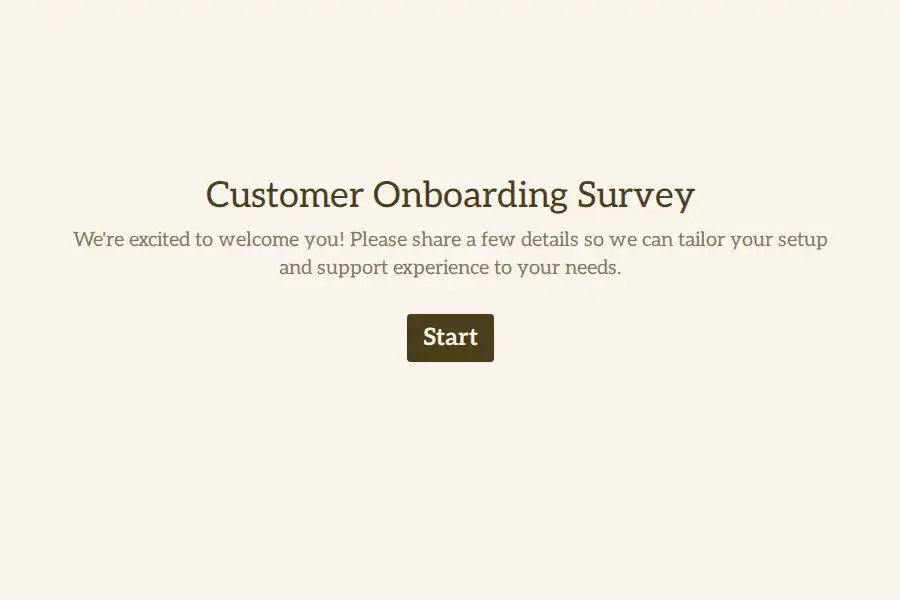


Customer Onboarding Survey Template
The first kickoff call with a new client follows a script everyone knows: forty minutes of discovery — what are you hoping to achieve, what tools do you use, when do you want to launch — and twenty minutes of actual planning. The discovery portion is necessary and entirely mechanical, which is exactly why it shouldn’t consume the meeting. A pre-kickoff brief, sent the day the contract signs, collects all of it in the client’s own time — and converts your kickoff from an interview into a working session on a plan.
A Brief, Not a Survey
This instrument has a different job from every satisfaction or feedback form: nothing here asks how the client feels. It asks how their rollout should be built. Framing matters — the invitation should say help us prepare your implementation rather than tell us about your experience. Clients answer requirements questions readily; they answer questionnaires reluctantly. Same fields, different posture.
What the Brief Establishes
Six blocks turn a signed contract into a prepared kickoff:
- The definition of success — what does win look like ninety days from now? In the client’s own words via a long text question. This single answer becomes the implementation’s north star — and, later, the renewal conversation’s benchmark
- The team map — who’s involved, their roles, and who signs off. Implementations stall on unidentified stakeholders; names on paper at day zero prevent the approval that arrives from nowhere in week six
- The current tool stack — what they use today, selected from a multiple choice list you maintain. Integrations, data migration, and the we didn’t know you also used X conversations all surface here, before they become surprises
- The timeline reality — their target launch date via a date field, plus what’s driving it. An event, a contract deadline, a fiscal year — the why behind the date determines how hard it can bend
- Support format preferences — live calls, written guides, video walkthroughs, or a mix. Training shaped to preference lands twice as fast as training shaped to habit
- Known constraints — security reviews, procurement cycles, holiday blackouts, the person who’s out for a month. The obstacles that derail rollouts are rarely secret; they’re just never asked about early enough
The Kickoff That Follows
With the brief in hand, the kickoff call changes shape: agenda circulated in advance, integrations pre-identified, milestone draft already sketched against their stated date. The call spends its time on decisions and edge cases — the only parts that genuinely need everyone in the room. Clients notice the difference immediately; a vendor who did the homework before the first meeting sets the tone for the entire engagement.
Milestones, Anchored to Their Own Words
The brief keeps earning after kickoff: recall the client’s stated goals in every milestone check-in — you told us the priority was getting your field team live by March; here’s where that stands. Progress measured against the client’s own definition of success reads as partnership. Progress measured against yours reads as a report card. Route each brief to the implementation lead the moment it lands, so preparation starts before the calendar invite does.
Frequently Asked Questions
When should the brief go out?
The day the contract signs — while momentum and goodwill are both at their peak. Clients complete requirements questions eagerly in the honeymoon window and grudgingly two weeks later, when their team has already started asking them questions your brief should have answered.
Who on the client side should complete it?
The project owner — the person accountable for the rollout — with input gathered from their team as needed. One submission from the accountable party beats three partial ones from people who each know a third of the picture; the brief can invite them to consult colleagues on the tool and timeline sections.
What if the client can't answer some sections?
Incomplete answers are themselves useful data: a client who can’t name a launch date or a success definition isn’t ready to implement, and it’s far better to learn that at kickoff than in week five. Where the brief comes back thin, the kickoff call’s first agenda item writes itself.
How is this different from an onboarding feedback survey?
Timing and direction. This brief flows toward the work — requirements, context, and constraints collected before implementation begins. An onboarding feedback survey flows back from it — how the setup experience felt once underway. Both belong in a healthy customer lifecycle; confusing them produces either a kickoff without context or feedback without an implementation plan behind it.
Does a brief like this genuinely affect retention?
Indirectly but powerfully: implementations that start with documented, client-stated goals reach first value faster — and time-to-first-value is the strongest early retention signal that exists. The brief also builds the shared record that later conversations lean on: renewals, expansions, and executive reviews all go more smoothly when the account’s original intentions are written down where everyone can see them.