
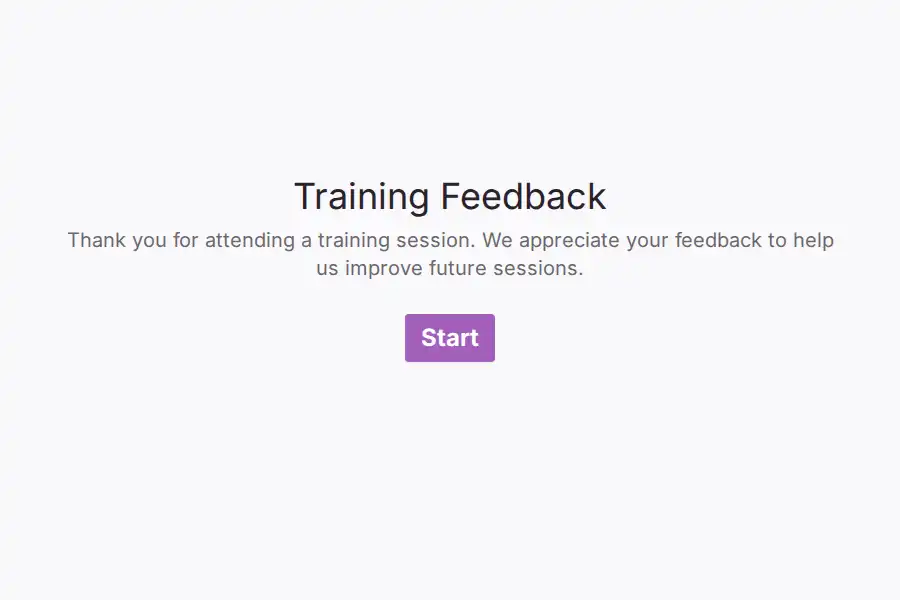
Training Feedback Form Template
Feedback collected three days after a workshop is a reconstruction. Feedback collected while participants are still seated is a memory. This training feedback form template is designed around that difference: a five-question pulse, handed out as the session wraps, that routinely gathers responses from nearly everyone who attended — making it the fastest-running member of the feedback forms collection.
The Five Questions
Short forms get finished, and these five still cover the ground that matters:
- Overall rating on a five-point rating scale — one number you can trend across every session you run.
- Trainer clarity, so facilitation gets judged separately from content.
- Relevance to your role on an opinion scale — the best early predictor of whether anything learned survives contact with the daily workload.
- Most valuable takeaway as open text, often the answer that reshapes how you position the course internally.
- Would you like someone to follow up with you? — a yes/no that quietly turns a feedback form into a pipeline of engaged employees worth interviewing.
That final question does double duty: it flags confused participants who need help now, and surfaces enthusiasts who make excellent ambassadors for the next rollout.
Distribution That Collects Responses
Email is where feedback goes to be ignored. Put the form where participants already are, at the moment the session ends:
- Flash a direct form link or QR code on the closing slide and hold the room for four minutes.
- Drop the link into the video call chat on virtual sessions while cameras are still on.
- For field teams and distributed workforces, share through WhatsApp so the link lands on the device people reflexively check.
- Switch on instant notifications so each submission reaches your inbox the moment it arrives — a troubled session becomes same-day signal instead of month-end surprise.
Making Sense of a Stream of Pulses
One form’s worth of feedback is anecdote; ten sessions’ worth is a pattern. Sort by trainer and topic every few weeks. Clarity scores sagging for one facilitator across multiple sessions means coach; relevance sagging for one course across multiple facilitators means retarget the audience or rework the content. Teams treating each pulse as a one-off survey collect plenty of data and use almost none of it — the review cadence is what converts volume into improvement. Broader listening programs live in the get feedback collection if you want to extend beyond training.
Frequently Asked Questions
Is five questions enough to evaluate a training session?
For a pulse, yes — the goal is a fast read on quality, relevance, and who needs follow-up. When a specific course faces a bigger decision, run a longer evaluation for that program instead of inflating the pulse for everyone.
Can feedback stay anonymous if we ask for follow-up consent?
The two coexist: keep ratings anonymous, and let the follow-up question gather contact details only from those who opt in. People who want a conversation volunteer; everyone else stays anonymous, and candor survives intact.
What should I do with a session that scores badly?
Read the written answers first — they usually explain the numbers. Then contact the participants who requested follow-up, since they already volunteered to elaborate. Fix the specific cause before the next cohort rather than rewriting the course on the strength of one bad room.
How do I run the same pulse across many trainers?
Duplicate the form per trainer or per session and keep the questions identical. Consistent questions are what turn a pile of individual surveys into a comparison an L&D lead can act on.