



License Applications Fail on Paperwork, Not Romance
Ask any clerk’s office why applications get turned away and the causes are unromantic in the extreme: a name on the application that doesn’t match the passport, a divorce decree from 1998 sitting in a drawer two states away, a birth certificate issued in a language the office can’t read. The couple is eligible, the ceremony is booked, and the application fails anyway — because nobody assembled the file before the appointment.
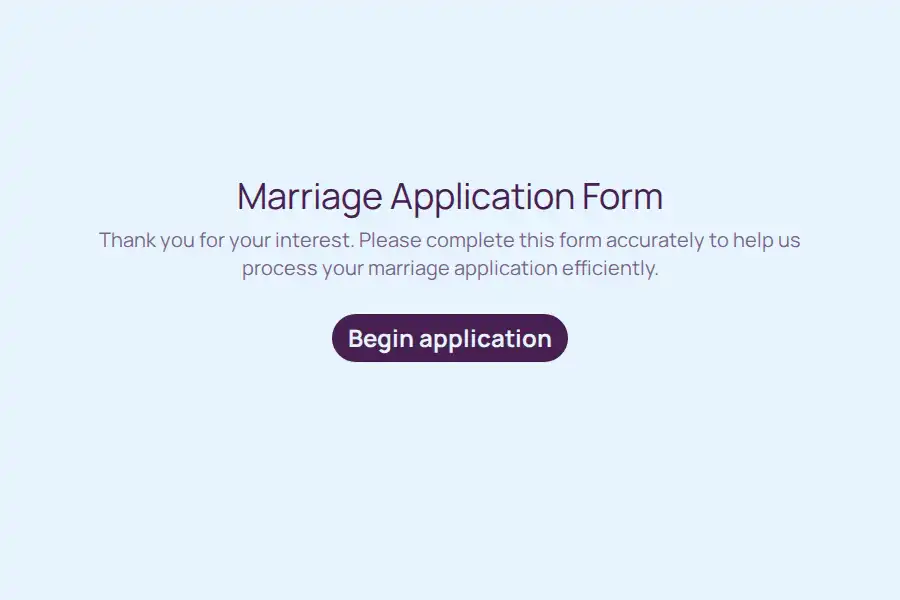
This marriage application form template is the file, assembled in advance. Both partners complete one structured submission with every supporting document attached, and your office reviews a complete package instead of conducting document archaeology at the counter. Applications arrive approved-able; couples arrive once.
The Core Application, Completed Once
The joint submission captures both partners’ legal particulars side by side: full names exactly as they appear on identity documents, dates and places of birth, current residential addresses, and contact details. The instruction printed at the name fields — match your ID character for character — prevents the single most common rejection before it happens. One coherent application replaces the mismatched half-forms that offices currently reconcile by phone.
The Document Pack, Attached Where It Belongs
Every office maintains a list, and the form turns it into required uploads: government photo ID for each partner, birth certificates where required, and proof of residency. Documents attach to the application rather than accompanying it, which changes the review entirely — your staff can verify a file over coffee instead of at a counter, and couples learn about a problem while there’s still time to fix it.
The Prior-Marriage Section — the Rejection Engine
If one field causes more returned applications than all others combined, it’s this one. The form handles it deliberately: a yes or no question on any previous marriage per partner, opening — where answered yes — structured fields for the former spouse’s name, the date and manner the marriage ended, and the documentary proof: final decree, dissolution order, or death certificate, uploaded directly. Conditional logic keeps the section invisible to first-time applicants and unavoidable for everyone it concerns, and a long text field lets applicants explain anything unusual — the decree under a prior name, the annulment still being finalized.
When Names Don’t Match
Marriage-driven name changes, hyphenations adopted years ago, transliterations from another alphabet — any gap between the application’s name and the identity document’s name needs a connecting document, and the form asks for it: the deed poll, the prior certificate, the court order, uploaded alongside the ID it explains. Caught at application, a name question costs one upload; caught at the counter, it costs the couple a second trip and your office an unresolved file.
Papers in Other Languages
Foreign-issued documents are welcome in most offices — in certified translation. The upload section takes both the original and its certified translation together, with a note encouraging applicants to order translations early, since this is the step with the longest lead time in the entire process. Where documents need an apostille or legalization, the application flags it at the source.
Review, Flag, Fix — Before Anyone Drives Downtown
Each submission lands in your office’s review queue with an instant alert, and every applicant receives a confirmation email stating their file’s status and anything outstanding. Because document gathering takes evenings — decrees ordered, translations commissioned — partial submissions hold a half-built application safely while the paperwork arrives. Application-style intake sits beside the application templates collection and the wider event planning library.
Frequently Asked Questions
What documents does a marriage application typically require?
Government photo ID for each partner, and — depending on your jurisdiction — birth certificates, proof of residency, and evidence of how any previous marriage ended. The form’s required-upload structure mirrors your office’s exact list, so applicants see it before they submit rather than after.
One of us is divorced. What does the application need?
The decree or order that finally ended the marriage — not just the separation. The prior-marriage section collects the details and the document together, which is what lets your office clear the file in one review instead of requesting proof twice.
My name doesn't match my passport. Can we still apply?
Usually yes, with the connecting document: a deed poll, marriage certificate, or court order explaining the change. Upload it with the application and the name question is resolved on paper rather than argued at the counter.
Do foreign documents need to be translated?
In most offices, yes — a certified translation, submitted alongside the original. Advise applicants to commission translations early; it is reliably the longest lead-time item in the whole file, and the form flags it at the start.
Can couples submit before they've gathered everything?
They can start and pause — partial submissions preserve their progress while decrees and translations arrive. Your office sees only completed files, and applicants see exactly what’s still missing via the confirmation email.
How does our office track which applications are incomplete?
The review queue shows every file with its completeness at a glance — what’s attached, what’s flagged, what’s waiting. Staff chase the gaps rather than discovering them appointment by appointment.