


Hear Every Stakeholder Before the Planning Meeting Starts
Quarterly planning has a familiar failure mode: the loudest voice in the room becomes the roadmap, quieter objections surface two months too late, and the team discovers in week nine that sales and marketing never agreed on what counts as a qualified lead. The information needed to prevent this already exists — inside people’s heads, in formats nobody can compare.
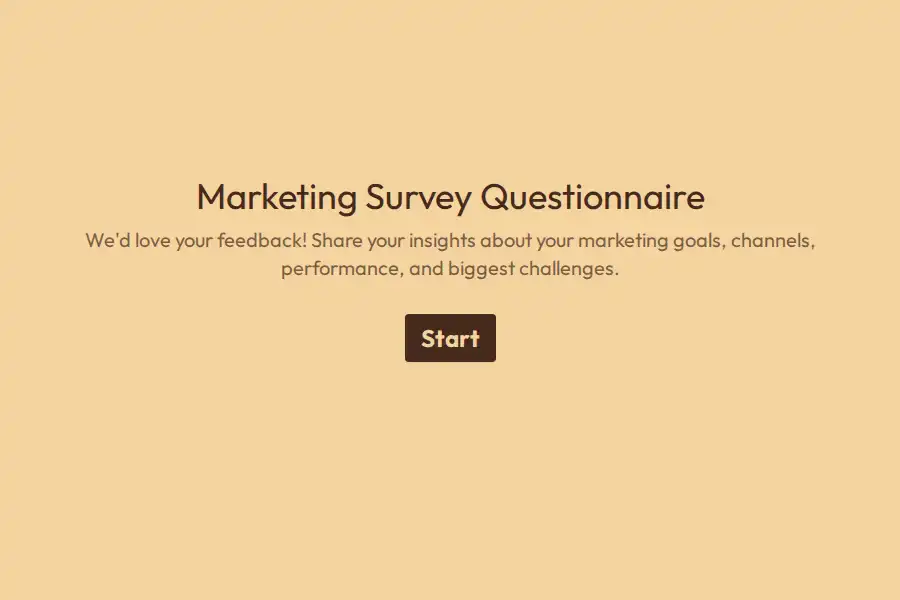
This marketing survey questionnaire fixes the input problem. Circulate it to everyone with a stake in the plan — practitioners, sales leadership, product, founders — before the session, and arrive with every perspective mapped, comparable, and impossible to talk over.
A Question Set Built to Expose Misalignment
- Role and vantage point — which function the respondent sits in, so answers get compared across teams instead of averaged into mush.
- The priority that matters most — what marketing should optimize next quarter: pipeline, retention, brand, product launches, or something else.
- Confidence in the current strategy — a 1–10 opinion scale; a median of 4 entering planning is a finding, not a crisis.
- The bottleneck diagnosis — open-ended: what single thing most limits marketing performance right now?
- Next quarter’s channel bets — multiple choice selections showing where people would actually invest.
- The qualified-lead definition — a short written definition from each respondent. The sales version and the marketing version almost never match, and the gap is the meeting’s most valuable agenda item.
- Stack weaknesses — where current tooling falls short of what the plan requires.
- Appetite for experiments — how willing the team is to test unfamiliar channels, messages, or processes.
- The one change they’d make — a closing open question that surfaces ideas nobody says aloud in meetings.
Re-Run It Every Cycle, Not Once a Year
Plans drift. The survey that felt settled in January can be fiction by April. Teams that re-circulate the questionnaire at the start of each planning cycle can duplicate the form in seconds, keep wording identical so responses stay comparable across quarters, and track how confidence and priorities shift over time.
Circulation matters as much as wording — the survey response rate calculator helps you size the audience and set realistic expectations for how many completed responses a cycle needs before the results mean something.
Read the Spread, Not the Average
The value is not the consensus answer — it is the dispersion. If marketing rates channel performance 8 out of 10 while sales rates it 3, you have found the real agenda item before anyone sits down. Filter submissions by role in the response view and present the disagreements deliberately rather than smoothing them over.
Treat this as the qualitative layer beside your dashboards: analytics tell you what happened, this tells you what your stakeholders believe happened and want next. Teams formalizing the practice often fold it into broader market research programs, and sibling formats live in the marketing surveys collection and the general surveys library.
Frequently Asked Questions
What is a marketing survey questionnaire for?
Collecting structured, comparable perspectives from everyone with a stake in marketing performance — priorities, confidence, bottlenecks, channel preferences, and definitions of success — typically ahead of planning sessions or strategic reviews.
Who should receive it?
Anyone whose buy-in the plan needs: the marketing team, sales leadership, product managers, customer success, and executive stakeholders. Cross-functional responses are where the interesting gaps appear.
How many questions is the right number?
Eight to ten takes respondents under five minutes and keeps completion rates high. Anything longer tends to collect rushed answers that defeat the purpose of comparable data.
What should I do when answers contradict each other?
Put the contradiction on the agenda instead of resolving it privately. A documented disagreement between sales and marketing over lead quality is exactly the conversation planning exists to settle.
Can the same questionnaire be reused next quarter?
Yes — duplicating it each cycle with identical wording preserves comparability, so you can track whether confidence, priorities, and perceived bottlenecks actually moved after the previous plan.