
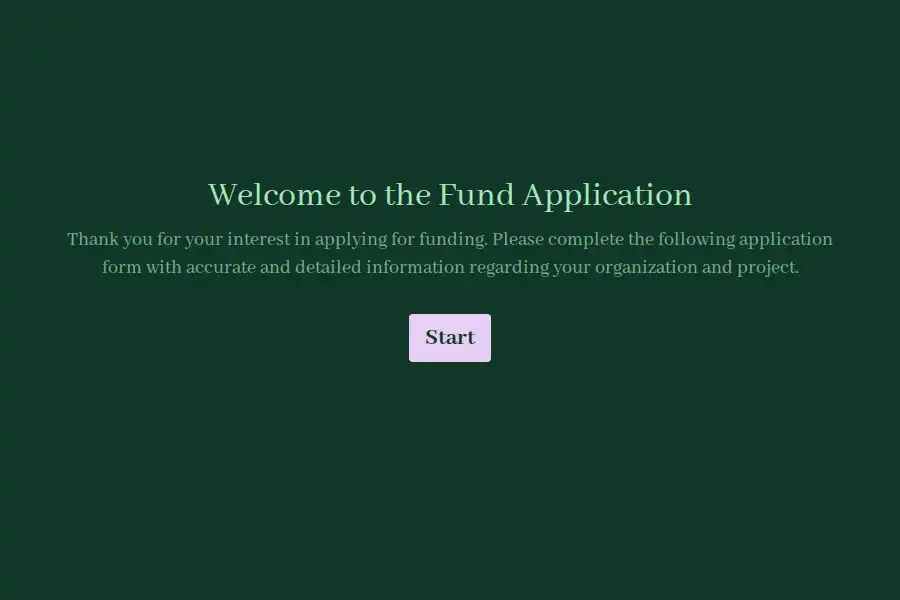


Fund Application Form Template
A grant round is judged by its intake whether the funder admits it or not. Applications arrive in fifteen formats, eligibility gets discovered after review rather than before, and the committee’s first meeting is spent reconciling documents instead of comparing projects. The fix is unglamorous and total: one standard intake, designed around the reviewer’s scoring sheet rather than the applicant’s writing style. This template is that intake — built for program officers and fund administrators who want every application to arrive pre-screened, pre-structured, and ready to be placed side by side.
Design the Form Backwards From the Scoring Sheet
The mistake most application forms make is collecting what’s easy to ask instead of what reviewers score. Start from the rubric: if the committee awards points for feasibility, impact, budget realism, and organizational capacity, then each criterion needs a field — or several — that produces evidence for it. A criterion with no corresponding question gets judged on prose quality, which is how well-funded ideas lose to well-written ones. Map every scored criterion to its questions before writing a word of the form, and the application writes itself in the right order.
Eligibility Gates Before Effort
Nothing breeds resentment like a small nonprofit writing a full proposal before discovering the fund’s floor is organizations twice their budget. Put the disqualifiers first, as a short block of yes/no screeners:
- Organization type and registration status
- Geographic eligibility — where the work happens, not where the office sits
- Request amount within the round’s range
- Years operating, or other capacity floors
- Any exclusions the fund’s charter imposes
Ineligible applicants exit in ninety seconds with their goodwill intact — and a short, respectful exit message on the closing page turns no into not this round. Eligible applicants reach the long form knowing they belong there, which measurably improves completion quality.
The Standard Field Set
The body of the application mirrors what a review committee actually compares:
- Organization identity. Legal name, registration details, website, and a classification dropdown matching your fund’s own categories — so filtering later costs nothing.
- The project in one line. A short-text field forcing the project to a single sentence. This field becomes the committee’s agenda document and your summary sheet; applicants who can’t write it have told you something important.
- The request. Amount as a structured number — never free text — with period covered and what it funds.
- Timeline. Start and end dates, enabling the committee to see at a glance which projects are ready versus aspirational.
- Narrative and metrics. The need, the approach, the beneficiaries, and how success will be measured — each in its own labeled section so scoring maps directly to answers.
- Attachments. Budget file, registration documents, and letters of support via document uploads, kept attached to the application they belong to.
- The declaration. A closing legal acknowledgment confirming accuracy — the field that makes the application a representation rather than a conversation.
Rounds, Deadlines, and Cycles
Funds live on cycles, and the intake should obey them. Duplicate the form per round rather than reusing a living document — each round becomes a frozen, comparable dataset, and year-over-year analysis becomes possible. Rename each copy to carry the round and year, state the deadline in the form’s opening text, and close the form at the deadline so just one more has nowhere to land. For rolling programs, the same structure works with the deadline language swapped for review cadence.
The Review Desk
Standardized intake pays its dividend at committee time. Applications assemble in the response dashboard as comparable rows — same fields, same order, attachments attached — and the committee’s first meeting starts at comparison instead of assembly. Give reviewers access through a shared workspace with role-based permissions: panel members see applications, observers see summaries, and nobody edits a live application. Where your grants system accepts data, a webhook carries each application across on arrival, and every applicant receives an automatic confirmation with their answers — the receipt that prevents the did you get it emails during review week.
The Applicant Experience Is Part of the Assessment
How hard your form is to complete tells applicants what kind of funder you are, and the best applicants are paying attention. Keep required fields to what genuinely gates a submission using required-question settings; let everything else breathe. Long applications benefit from partial submission capture — organizations assembling budgets and letters over weeks can build across sessions without losing work. Host the intake on a custom domain so applicants never wonder whether the form belongs to your fund. Drop-off patterns in a well-built form are diagnostic: if a third of applicants abandon at the budget section, the section — or its instructions — needs work, not the applicants.
For the wider grant and giving ecosystem, see the nonprofit template collection and the application forms library.
Frequently Asked Questions
How do we handle applications that arrive incomplete or malformed?
The standard intake prevents most of the problem — required fields block incomplete submissions by construction. For the residue, decide the policy before the round opens and print it in the form: minor gaps get one cure window with a deadline, major gaps are declined with the reason stated. The destructive pattern is silent triage — quietly discarding imperfect applications while applicants believe they’re under review. Whatever your rule, the confirmation email’s timestamped record settles every we submitted on time dispute.
Can reviewers score applications inside this, or do we still need spreadsheets?
The intake’s job is making review fast, not replacing your scoring process. Structured fields mean the side-by-side comparison — amounts, timelines, metrics, budget files — happens in one view instead of across fifteen documents, and each reviewer can work their assigned applications through controlled workspace access. Committees that score in their existing rubric tool will find the exports drop straight in; committees that score in a meeting will find the agenda pre-built.
Fixed rounds or rolling applications — which should we run?
Fixed rounds suit most funds: they create fair comparison (everyone assessed against the same cohort), concentrate review effort, and give the committee a rhythm. Rolling intake suits emergency funds, small recurring grants, and programs where speed to decision is the point. If you run both — a flagship annual round plus a rolling small-grants stream — run them as separate forms so the comparison sets never contaminate each other.
How do we reduce drop-off on a genuinely long application?
Diagnose before you shorten: partial submissions show you exactly where applicants stop, and the fix depends on the spot. Abandonment at eligibility means your gates are unclear; at the budget section means applicants lack the file ready or the instructions are thin; scattered across the narrative means the form is simply long, and the honest fixes are a stated question count upfront, savable drafts, and publishing the word guides that turn describe your approach into something answerable. A form applicants can finish beats a form that flatters your rigor and collects half-applications.