
Your Product Is Coverage. Hire for the Grid.
A security company doesn’t sell guards — it sells a grid: every post, every night, every weekend, covered without exception. That reframes hiring completely. A chartered-institute-certified officer who won’t work Sundays is worth less to your roster than a steady, presentable guard who’ll take the graveyard shift at short notice. The gap between a full grid and a penalties clause is almost never licensing — it’s availability nobody screened for at application.
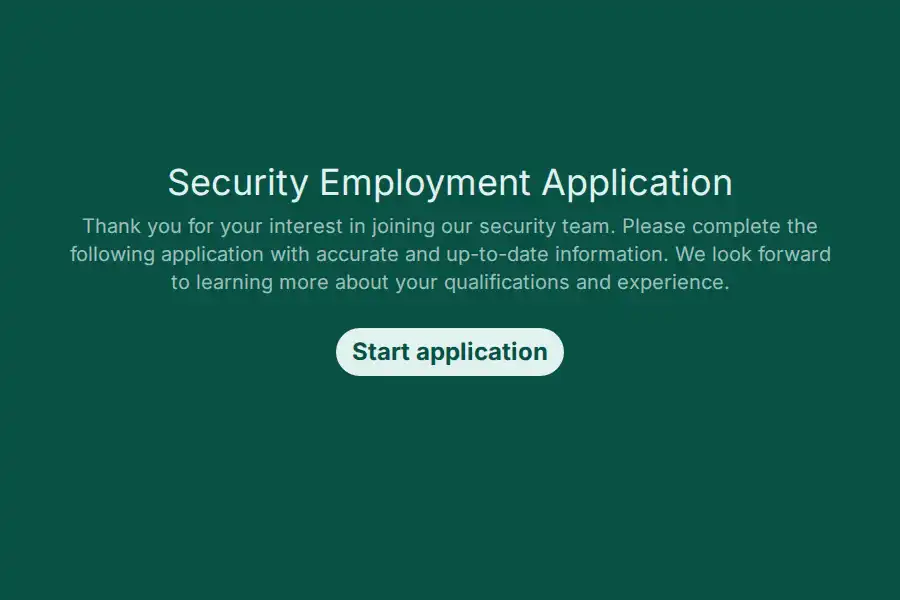
This security employment application form template is built by the logic of the roster: what posts can this person hold, which shifts will they actually work, when does their license expire, and will they represent your client’s front desk well at 2 a.m.
Screen the Grid First
- Shift patterns, asked bluntly — a multiple choice covering days, nights, swing, weekends, overtime, and the make-or-break question for any contractor: short-notice call-outs. Answers should be treated as commitments; make the availability questions required so no application arrives unmatchable.
- Post fit — static and concierge posts, mobile patrol, retail floors, event security, control room: another multiple choice mapping applicants to the work your contracts actually contain. Tag each hiring campaign’s link with hidden fields — client site, post, branch — and applications file themselves against the contract they’ll staff.
- The patrol driving question — a yes or no on holding a full driving license, separate from the security license itself. Mobile patrol contracts live and die on this single yes.
Licensing, With the Expiry in Writing
A guard’s license is the contract’s legal spine, so collect it as data: license status and class via a dropdown, the expiry date as a date field, and a scan through file upload. An expiry captured at application is a renewal reminder you schedule; an expiry nobody recorded is a guard pulled from a post mid-shift when the client’s audit finds it. The same applies to first-aid and any crowd-safety credentials worth tracking.
The Client-Facing Basics
Guards are the most visible person on your client’s property, so the application asks what CVs hide: comfort with public-facing concierge work, report-writing ability, the languages they speak beyond the working language — a short text field that quietly wins retail and hospitality contracts — and a plain physical readiness confirmation via yes or no. A contact info field opens the application, because guard hiring moves at phone speed.
From Application to Post in Days
Every application alerts the staffing desk instantly, and the response view filters by shift pattern, post type, and license validity — which is exactly the filter a 9 p.m. call-out needs. When a post fills, close that form and let the next variant carry the load; run a variant per client site and duplicate the master whenever a new contract lands. Approved applicants can be sent straight to orientation booking with a custom redirect, and guards talk to guards — share the application into security WhatsApp groups where referrals actually circulate. Multi-branch operators keep each branch to its own pipeline with role-based access. This template sits with the job application collection, the employment sub-category, and the wider recruit talent library.
Frequently Asked Questions
What licensing details should the application capture?
License status and class, the expiry date as a structured field, and an uploaded copy. The expiry date is the detail that prevents a mid-contract withdrawal — track it the moment the application lands.
How do we reliably fill night and weekend posts?
By asking about them as explicit commitments at application, not discovering preferences at roster time. Filter the response view by shift pattern when a night post opens, and the candidates who chose nights surface immediately.
Can one application cover multiple client sites?
Yes — run a variant per site with hidden-field tags, so every application is pre-attributed to the contract and branch it belongs to, and branch managers see only their own pipelines.
Should we require a driving license for every guard?
No — only for mobile patrol roles, which is why it’s a separate yes/no question rather than an assumption. Static and concierge posts don’t need it, and requiring it universally shrinks your hiring pool for no operational reason.
What client-facing questions are worth asking?
Public-facing comfort, report writing, and additional languages. Concierge and retail clients notice all three in the first week — and they’re exactly the qualities no license check will tell you about.