

An Academy Seat Costs Thousands. This Form Costs Minutes.
Law enforcement recruiting is a funnel with brutal economics: written exams to staff, physical assessments to run, oral boards to convene, background investigators to assign — all before a single recruit reaches the academy, and all spent on candidates who may not meet the age minimum. Every agency that has ever sat a candidate for a written exam only to fail them on citizenship paperwork knows the arithmetic. The application is the cheapest elimination round you will ever run.
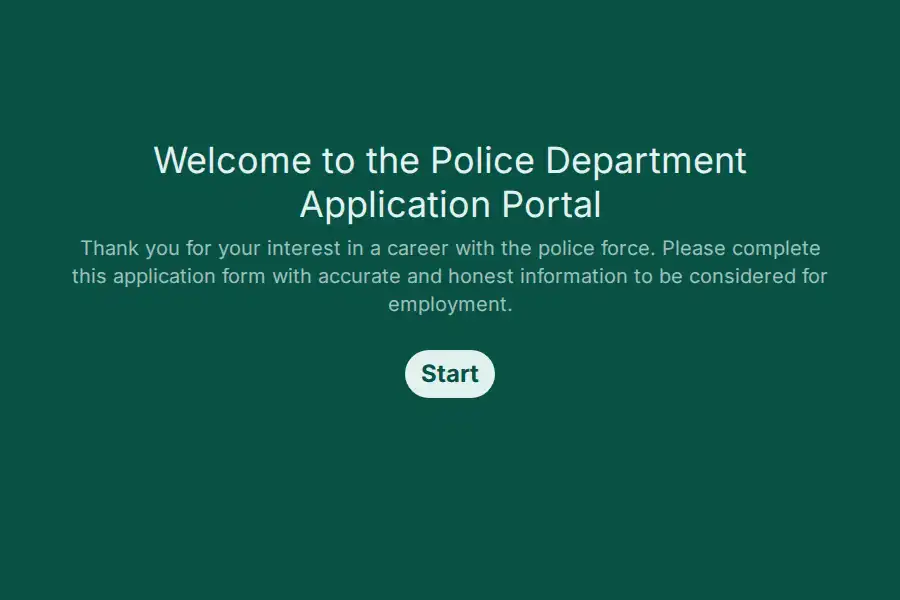
This police job application form template is designed as the funnel’s gate: eligibility settled in black and white, preference points claimed and documented, and qualified applicants registered into the testing sequence while their motivation is at its peak.
The Eligibility Gates, Settled Upfront
Structure every disqualifying threshold as its own explicit question, so the recruiting unit filters instead of reads:
- Age minimum — date of birth via a date field; the department’s threshold applies itself.
- Citizenship or work authorization — a yes or no question with the jurisdiction’s rule stated plainly in the question.
- Driving license — status captured directly, since most operational roles require one and lapsed licenses fail candidates later at ten times the cost.
- Education floor — high school, GED, degree, or military service equivalency, selected from a dropdown matching your standards.
Every gate is a required field: an application that cannot clear eligibility is never submitted, and nobody spends assessor hours discovering that in person.
Preference Points, Claimed and Documented
Civil service systems award preference for military service, residency within the jurisdiction, and in many agencies, prior certification — and unclaimed points generate appeals. The form captures each: veteran status with a DD-214 attached through file upload, residency confirmation, and a yes or no on current or lapsed POST-equivalent certification. Documenting the claims at application is what makes the eligibility list defensible when it’s challenged.
Entry, Lateral, or Civilian — Routed From the First Screen
A dropdown separates entry-level officer applicants from laterals — experienced officers transferring in, who often skip the written exam entirely — and from civilian positions: dispatch, records, corrections, community services. One recruiting campaign serves every opening, and hidden fields tagged per posting keep each intake cohort cleanly attributed.
Feed the Testing Calendar Directly
The application’s final section registers qualified applicants into the sequence: availability for the next written exam and physical assessment dates, captured via date fields. From there, a custom redirect sends applicants straight to the test-slot booking page, webhooks push each registration into your applicant tracking system, and when the exam room is full, close the form so the next intake opens clean. Duplicate the form for each testing cycle and the questions that took weeks to draft take seconds to reuse. Partial submissions save long applications mid-flight — a real concern when applicants complete them on phones between shifts — and a progress bar keeps them moving to the end. Recruits who pass belong next to the employee onboarding workflow; the recruiting toolkit around this form lives in the job application templates, evaluation surveys, and the recruit talent library.
Frequently Asked Questions
Which eligibility requirements should be verified before testing?
Whatever disqualifies in your jurisdiction: age minimum, citizenship or work authorization, driving license, and the education floor. Every one becomes a filterable field — the recruiting unit sorts the eligible from the ineligible instead of reading files to find out.
How are veteran and residency preference points handled?
Claimed at application and documented: veteran status with the DD-214 uploaded, residency confirmed, prior certification declared. When the eligibility list is later challenged, the claims and their evidence are already on file.
Can one form serve lateral transfers and civilian roles?
Yes — a position dropdown separates entry-level officers, laterals, and civilian positions like dispatch and corrections, so the same intake runs every opening, with routing handled by the applicant’s own selection.
How do applicants register for written and physical test dates?
The application captures their availability for the scheduled testing windows and redirects them to your booking page on submission. Webhooks can carry each registration into your scheduling system automatically — no clipboard lists at the exam door.
What happens between testing cycles?
Close the application when exam seats fill, and duplicate it for the next cycle — wording identical, dates refreshed. The form becomes reusable recruiting infrastructure rather than a document rebuilt every intake.