
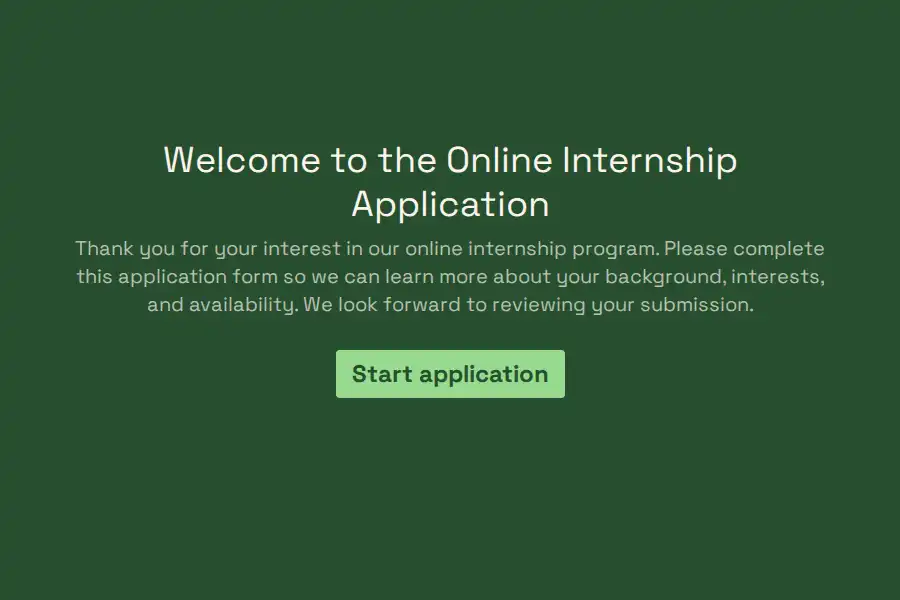
Online Internship Application Form
Remote internship programs broke the old constraints: no relocation budget, no commuting radius, no we-only-hire-from-the-three-universities-near-the-office. The candidate pool is now the world — which is simultaneously the opportunity and the problem. Your next great intern may be nine time zones away, or entirely wrong for asynchronous work despite a dazzling interview presence. Charm over video correlates weakly with async delivery; the signals that actually predict remote success are different, and a form inherited from office-era hiring does not collect them.
This online internship application form collects what remote screening actually runs on: time-zone fit, self-direction history, async-proof portfolios, and the practical honesty about equipment that prevents the week-three reveal nobody enjoys.
Time Zone as a First-Class Field
Availability overlap determines whether a remote intern thrives or quietly drowns — a cohort spread across twelve hours cannot hold the weekly sync that makes internships feel supervised rather than abandoned. A dropdown of time zones, or preferred working hours, turns placement into a design task: build cohorts with genuine daily overlap, and place singleton time-zone interns in explicitly async-designed roles rather than silently hoping they adapt. Collected at application, this is a sorting field; discovered at onboarding, it is a scheduling crisis.
Remote-Readiness Signals
Predicting async success means weighting history over presence:
- Self-directed experience — remote coursework, freelance work, open-source contributions, projects finished without anyone watching. Prior unsupervised delivery is the strongest positive signal remote hiring has.
- A structured self-direction rating, captured on an opinion scale so every reviewer scores the same dimension the same way — across a global applicant pool, unstructured impressions diverge wildly.
- Specific remote collaboration experience — tools used, teams worked with across distance, the mechanics of how they actually worked.
Individually, none is decisive; together they separate candidates who have already worked without supervision from candidates who would be trying it for the first time on your budget.
Async-Proof Portfolios
Remote candidates demonstrate through artifacts, not office presence — so the application should make artifacts easy to submit and easy to review. A website field captures the living work: repositories, portfolio sites, published writing. A file upload collects the documents. Screening becomes a click-through of evidence rather than a leap of faith from a polished video call — and the candidates who look best in artifacts are, reliably, the ones who deliver best in artifacts.
Equipment and Connectivity, Asked Kindly
One discreet question — reliable internet, and access to the hardware the role needs — prevents the awkward week-three revelation that your fully-remote intern shares a laptop with three siblings. Ask it as capability rather than interrogation: what do you need from us to do this well? Framed that way, the question is both a filter and a support signal, and candidates answer it honestly.
A Pipeline That Never Sleeps
A global pool submits at every hour, and the infrastructure should treat that as normal rather than exceptional. Overnight submissions reach your team wherever they are via self notifications; every applicant worldwide receives an instant confirmation email so nobody waits a day-zone away wondering whether their application landed. Review happens in one dashboard rather than an inbox that fills while your side of the world sleeps. Early-career hiring formats across every model are gathered under the recruit talent templates category.
Frequently Asked Questions
How do we assess remote readiness without meeting candidates?
Weight artifacts and history over interviews: self-directed projects, remote or freelance experience, and specific examples of unsupervised work — plus one structured self-direction rating so reviewers stay consistent across hundreds of applicants. The interview still happens; it just stops being the only evidence.
How should international eligibility and payment be handled?
That is a legal and policy question before it is a form question — but structurally, collect location and work-eligibility information early in the application, so compliant pathways are decided by policy rather than discovered mid-hiring. The form’s job is to surface the facts; the policy’s job is to act on them.
What is the biggest screening mistake with remote intern applicants?
Overweighting interview presence. Charm over video correlates weakly with asynchronous delivery; portfolios, self-direction history, and time-zone fit predict the actual working relationship far better. Save interview weight for the questions artifacts cannot answer.
How should time zones shape cohort planning?
Collect preferred working hours from every applicant, then build cohorts with at least two to three hours of daily overlap. Interns in singleton time zones need explicitly async-designed roles — structured check-ins, written-first communication — not silent exclusion from a sync they cannot attend.
Should the form ask about equipment?
Yes, framed as capability and support: reliable internet, access to needed hardware, and what the candidate would need from you. It prevents quiet failures, and for programs that provide stipends or equipment, it tells you where the support actually goes.