
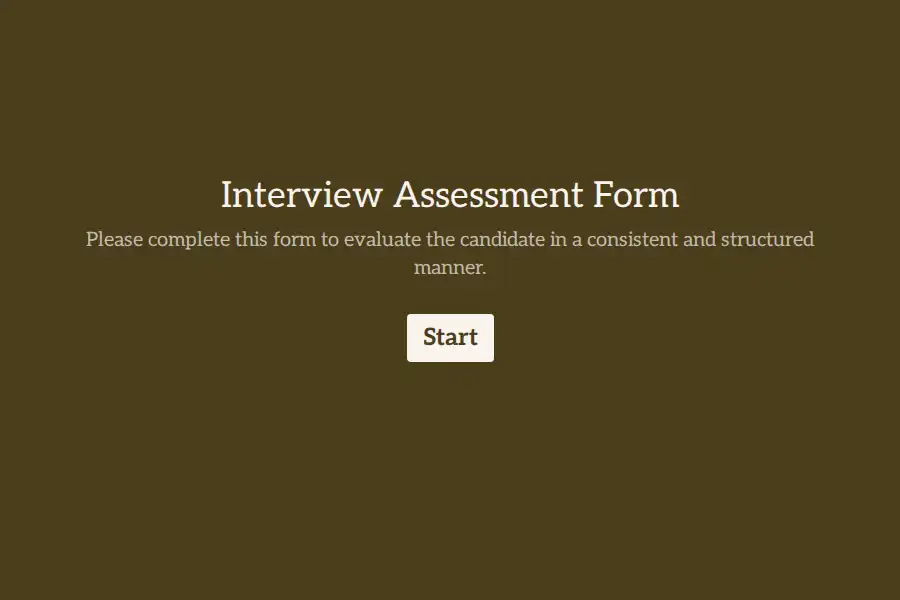
Interview Assessment Form Template
Two evaluators leave the same conversation convinced they met entirely different people. Multiply that across a hiring round and decisions start resting on whoever argues hardest in the debrief. The fix is unglamorous: a scorecard completed while impressions are fresh, scored against criteria that were written down before anyone shook hands.
This interview assessment form template gives every evaluator the same sheet for every candidate — identical dimensions, identical scales, identical space to record what was actually said. The output is a set of completed scorecards you can lay side by side, rather than a stack of conflicting memories.
What the Scorecard Collects
- Session details. Short text fields for candidate and interviewer names, a date question for the session itself, and a dropdown for round and format — phone, video, panel, or take-home follow-up. Format matters: a strong phone showing rarely survives contact with a whiteboard, and scores should be read with that in mind.
- Anchored scales. Each dimension — technical depth, problem decomposition, communication, collaboration — is scored on a rating question whose levels carry short behavioral descriptions. “Meets expectations” is a sentence describing observed behavior, not a number left to interpretation.
- Evidence lines. Beside every score, a long text question demands at least one concrete moment: the question that produced it, the answer that backed it up. A score nobody can defend in the debrief is a score that should not stand.
- Recommendation and flags. A dropdown records the call, from strong hire through strong no hire, while a yes/no question surfaces anything needing a second look — contradictions in the history, gaps the resume hid. Required fields keep evidence and flags from being skipped on a busy afternoon.
Getting Evaluators to Score Alike
A scorecard only works when two people watching the same hour of conversation land within a level of each other. Before the form goes live, walk every interviewer through the anchors, then have the team score one recorded or historical session and compare. Divergence of two or more levels on the same dimension is exactly where your next debrief argument would come from — settle it on paper now.
Bring the whole hiring team into a shared workspace so evaluators, recruiters, and the hiring manager all see completed forms, with role-based permissions deciding who can edit and who can only read.
Reading the Results
Completed scorecards arrive in the response view, where a full round of candidates can be compared dimension by dimension instead of anecdote by anecdote. When a new role opens, duplicate the form and swap the scored dimensions — the structure carries over. This template belongs to the evaluation sub-category within the wider human resources collection.
Frequently Asked Questions
Is a scorecard better than free-form interview notes?
Notes capture texture but resist comparison. A scorecard standardizes the judgment so five candidates produce five comparable sheets — most teams keep one short free-text section for anything the scales miss.
How many dimensions should one scorecard carry?
Four to six. Fewer and you are mostly measuring charisma; more and evaluators start rubber-stamping the middle of the scale just to finish.
What happens when two evaluators disagree by several levels?
Treat it as information. One of them likely saw something the other missed, so return to the evidence lines. If neither note supports the spread, the anchor wording for that dimension needs tightening.
Can a single scorecard serve every interview round?
Rarely. A phone screen, a technical round, and a values conversation measure different things. Keep the session-details block fixed, swap the scored dimensions per round, and label each version clearly.