
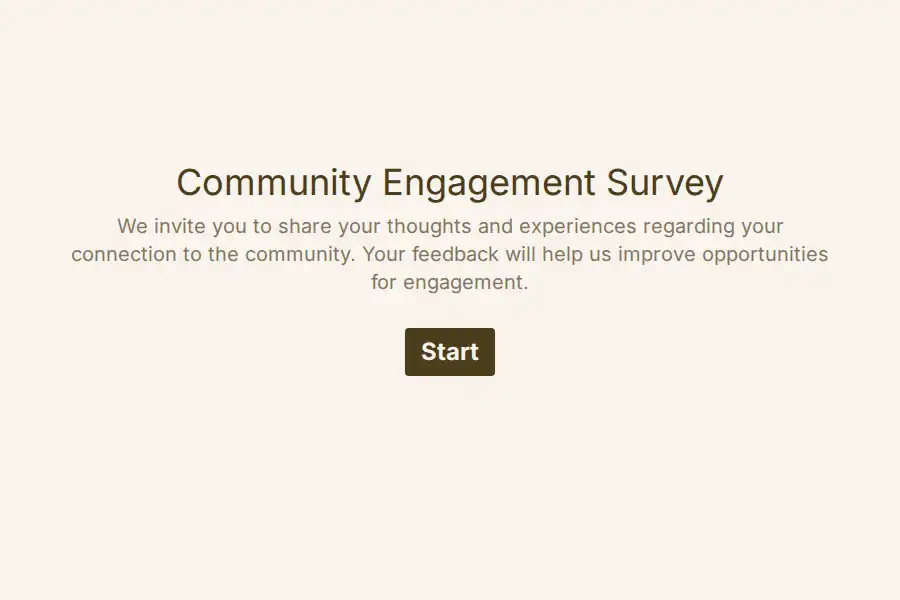
Community Engagement Survey Template
A community can look active from the outside while a growing number of members quietly stop participating. Attendance counts may show that fewer people are showing up, but they rarely explain why. A community engagement survey gives members a direct way to describe what keeps them involved, what they want more of, and what makes participation difficult.
This template measures connection, participation frequency, activity interests, motivations, barriers, satisfaction with current engagement opportunities, and ideas for improving participation and belonging. It also asks whether members want to hear about future opportunities, creating a natural starting point for continued communication.
Measure more than attendance
Counting event attendance or active users can tell you what happened. It cannot necessarily tell you how members feel about the community or what would encourage them to participate more often.
The survey adds several layers of context:
- Connection: Members rate how connected they feel to the community.
- Current participation: A multiple-choice question captures how often they take part in community activities or events.
- Interests: Members identify the types of activities they would most like to participate in.
- Motivation: An open response explores what personally encourages people to get involved.
- Barriers: Members can describe obstacles that make participation harder.
- Satisfaction: A rating question provides a measurable view of satisfaction with current opportunities.
- Improvement ideas: Members can suggest changes that could strengthen participation and belonging.
- Future contact: Members can opt in to hear about future opportunities and provide an email address if they want updates.
This combination helps distinguish people who are disengaged from people who are interested but facing barriers.
Ask members what is getting in the way
One of the strongest uses for this survey is diagnosing low participation. If members say they want to be involved but rarely attend, the next question should be what prevents them from doing so.
The barrier question is intentionally open-ended, allowing respondents to raise issues you may not have anticipated. Their answers might point to scheduling challenges, limited awareness of activities, uncertainty about how to participate, or other obstacles specific to your community. Do not assume the reason before asking.
Compare these comments with participation frequency and satisfaction ratings. A member who participates often may describe very different barriers from someone who rarely engages, and both perspectives can be useful when deciding what to change.
Use activity interests to shape programming
Community organizers often plan around what a small group of regular participants asks for. A survey can broaden that view by asking the wider membership which activities interest them.
Look for patterns in the multiple-choice responses and compare them with members’ stated motivations. If a particular activity has strong interest but low current participation, investigate what is preventing people from joining before concluding that the activity itself is unpopular.
The goal is not to promise every requested activity. It is to use member input as evidence when deciding which programs deserve attention, promotion, or experimentation.
Make the survey useful for different types of communities
The same basic engagement questions can be adapted for very different settings. A neighborhood association might focus on local events and participation opportunities. A nonprofit community could ask about volunteering and programs. An online group might concentrate on discussions, activities, and ways members want to contribute.
Customize the activity choices and language so members immediately recognize their own community. The underlying questions about connection, motivation, barriers, satisfaction, and belonging can remain useful while the examples and participation options change.
Turn responses into visible action
Collecting feedback without showing members what happened next can weaken trust. After reviewing responses, identify a small number of themes that can realistically influence your community strategy.
A practical review process is to:
- compare connection and satisfaction ratings with participation frequency
- group open-ended responses by recurring motivations and barriers
- identify activities with strong interest
- separate members who want future opportunities from those who do not
- choose changes that directly address recurring feedback
- communicate what you learned and what you plan to do differently
The template supports sending responses to Google Sheets or Airtable through Zapier, according to the supplied capabilities, which can make it easier to organize feedback for review and follow-up.
Improve response quality and participation
Keep the survey focused on decisions you actually need to make. Members are more likely to provide useful answers when the questions clearly relate to their experience rather than feeling like a generic census.
Share the survey through channels your community already uses, such as email, social channels, or a community page. A short, mobile-friendly experience can also reduce friction for people who are willing to give feedback but do not want to complete a lengthy questionnaire.
Most importantly, close the feedback loop. Tell members what you heard and explain which changes you are making. Visible action demonstrates that participation has a purpose and can encourage more members to contribute next time.
Frequently Asked Questions
What does a community engagement survey measure?
It can measure how connected members feel, how often they participate, what activities interest them, why they get involved, and what prevents them from participating. This template also measures satisfaction with current engagement opportunities and asks members what could improve participation and belonging.
Who can use a community engagement survey?
The template can be adapted for many types of communities, including neighborhood groups, nonprofit communities, membership organizations, and online groups. The important step is to tailor the activity choices and terminology to the environment members actually experience.
How can I find out why community members are disengaging?
Ask directly about barriers rather than treating reduced participation as proof that members have lost interest. The template includes an open-ended question about what makes participation harder. Compare those responses with participation frequency and connection ratings to identify patterns that may explain disengagement.
What should I do with open-ended community feedback?
Group responses into recurring themes such as motivations, barriers, desired activities, and ideas for improving belonging. Then compare those themes with the quantitative ratings and participation answers. Prioritize issues that appear frequently or that reveal a meaningful gap between what members want and what the community currently offers.
How can a community survey improve participation?
Use the responses to remove practical barriers, refine activities, and make opportunities more relevant to members. Follow through by sharing what you learned and which changes you are making. Members are more likely to see future surveys as worthwhile when they can connect their feedback with visible improvements.
Should I ask members for their email addresses?
Only ask for contact information when there is a clear reason to continue communicating with respondents. This template asks members whether they want to hear about future community opportunities and requests an email address if they choose to stay informed. Keeping that choice explicit helps separate feedback from ongoing outreach.