
Yes/No Questions Survey Template
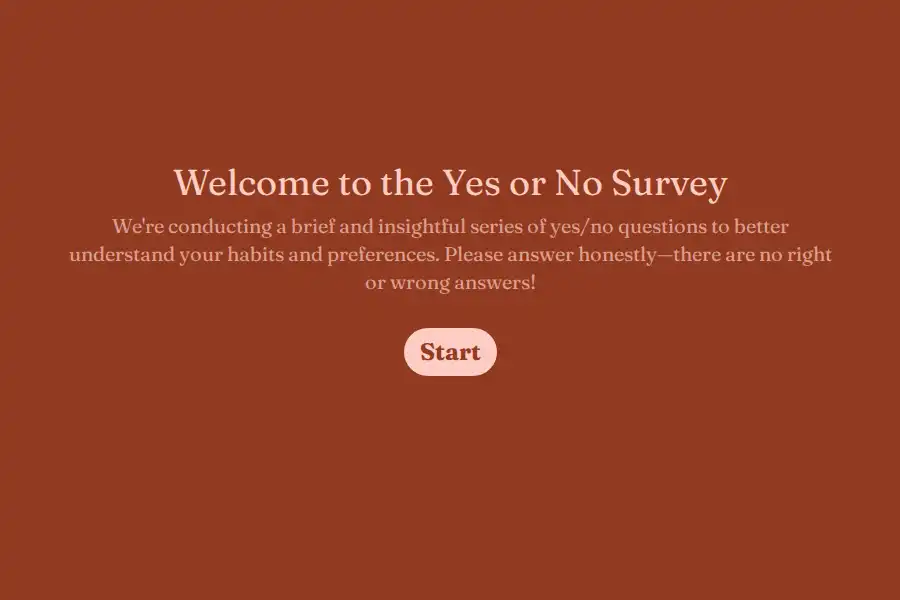
When customer surveys are too long or contain too many open-ended questions, completion rates often suffer. Many consumers are happy to share their opinions but will quickly abandon forms that feel like work. This yes/no questions survey template offers a fast, clean way to collect consumer preferences by presenting questions as simple, binary choices.
Eliminating dropdowns, rating scales, and text boxes allows participants to complete the survey in seconds, helping your team gather a large, clear dataset that is easy to analyze and act on.
Key Feedback Dimensions Covered by Yes/No Questions
This template uses clear, binary yes-no questions to evaluate consumer decision-making, shopping preferences, and user experience factors:
- Decision Pacing: Tracks if the respondent typically makes purchasing decisions quickly, helping define consumer profiles.
- Shopping Preferences: Evaluates online vs. in-store habits to help guide digital and physical channel investments.
- Social Proof and Influence: Explores if reviews influence shopping choices and measures the impact of positive brand experiences on peer recommendations.
- Incentives and Friction: Tracks engagement with discount sign-ups and measures checkout abandonment due to form length or complexity.
- Brand Trust and Ease of Use: Evaluates if website usability impacts brand trust and checks if a conversational form design improves response likelihood.
- Survey Completion Beliefs: Assesses respondent opinion on whether shorter survey formats are more likely to be completed, helping guide future feedback designs.
Where Yes/No Surveys Outperform Complex Forms
Yes/no surveys are highly effective for quick pulse checks, policy acknowledgments, eligibility screenings, and user experience reviews. By removing ambiguous middle options, you gather clean, decisive data that can be immediately sorted and analyzed without manual interpretation.
To make the most of this format, share the survey link via post-purchase emails, post it on social channels, or embed it on your site’s checkout confirmation pages to capture feedback while the user experience is still fresh.
Using Logical Follow-ups with Binary Questions
While yes/no questions are excellent for keeping forms simple, you can use conditional rules to display brief, targeted follow-up questions when a respondent answers “no” to a critical question. This keeps the survey incredibly fast for most participants while still capturing necessary details from those who flag a concern.
Frequently Asked Questions
What are the benefits of a yes/no questions survey?
It reduces form friction, leading to significantly higher completion rates. It also produces clean, binary data that is easy to segment, compare, and analyze without having to interpret open-ended responses.
When should we use binary choices over rating scales?
Use yes/no questions when you need clear, immediate answers (such as verifying eligibility or tracking simple habits) rather than measuring degrees of satisfaction or complex opinions.
Can we show follow-up questions only when someone answers "no"?
Yes. You can customize the form’s logical routing so that specific answers trigger follow-up questions, allowing you to collect extra details only when relevant.
How can we use yes/no feedback to improve conversion rate optimization?
Analyzing questions about checkout abandonment or website usability helps you pinpoint exact friction points in your purchase funnel, allowing your design team to make targeted improvements.