
Uncover Authentic Personal Insights Beyond Rehearsed Answers
Standard interview questions often lead to practiced, formulaic answers. When public figures, authors, team leaders, or brand founders are asked about their professional goals or career tips, they often reply with rehearsed talking points. To capture a genuine portrait of a subject’s values, fears, hopes, and inner life, you must change the nature of the questions. The Proust Questionnaire achieves this by posing distinct, deeply personal prompts that bypass the typical professional persona.
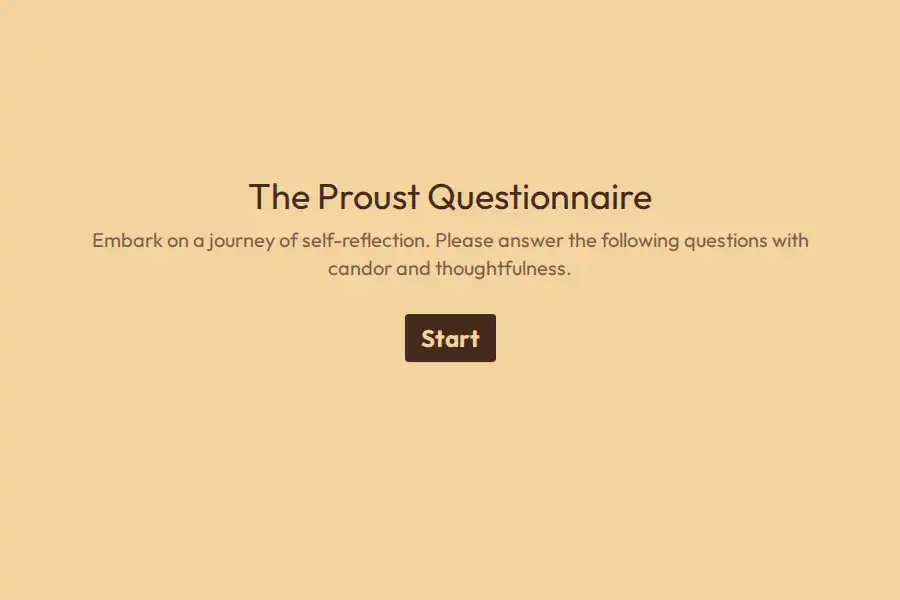
This Proust Questionnaire template provides a clean, distraction-free environment for subjects to reflect and respond to the classic 35 prompts. Showing one question at a time ensures that respondents give each introspective query their full attention, encouraging deeper, more considered answers that make for highly engaging profiles, bios, or team features.
The Historical and Professional Value of the Questionnaire
Originating as a Victorian parlor game and popularized by French writer Marcel Proust, this set of questions remains one of the most reliable methods for capturing an authentic personality profile.
- Promotes Genuine Self-Reflection: Because questions lack a clear “correct” answer, subjects are encouraged to reveal their true traits and views.
- Exceptional Editorial Resource: Journalists and content creators use the responses as a rich map of conversational threads to follow during in-person interviews.
- Unique Team-Building Activity: Sharing completed responses within teams builds deeper, more empathetic connections than typical professional bios.
Key Insights Captured by the 35 Prompts
This template delivers the complete, classic list of prompts in an organized, mobile-friendly digital layout:
- Ideal Reflections: Prompts explore the subject’s idea of perfect happiness, their current state of mind, their greatest achievements, and their happiest life moments.
- Dislikes and Distastes: Gathers reflections on what the subject deplores most in themselves, what they deplore in others, their biggest extravagance, and what they most dislike about their appearance.
- Admirations and Virtues: Asks about living people they most admire, historical heroes, favorite fictional characters, and what they consider the most overrated virtue.
- Deep Values and Quirks: Explores their greatest fear, their greatest regret, their favorite names, when and where they lie, and their personal motto.
- Creative Hypotheticals: Features deep-dive questions like where they would most like to live, what talent they wish they had, and who they would return as if reincarnated.
How to Leverage completed Questionnaires
If you are preparing a featured profile, send this questionnaire to your subject a few days before your scheduled conversation. Carefully review their answers to find surprising details—for example, an unexpected greatest fear or a highly specific childhood hero. Use these unique responses to structure your actual interview, bypass the standard introductory small talk, and jump straight into the narratives that make your subject truly unique.
Frequently Asked Questions
What is a Proust Questionnaire form?
A Proust Questionnaire form is a digital version of the famous 35-prompt personality assessment. It collects deep reflections on values, fears, habits, and preferences to construct an authentic, multifaceted profile of a subject.
Who should use this questionnaire template?
It is an exceptional tool for journalists writing profile pieces, content creators preparing guest spotlights, HR teams developing team-onboarding features, and organizations looking for unique community-building activities.
Do subjects have to answer all 35 questions?
While completing the entire set provides a highly comprehensive portrait, subjects can answer only the prompts they feel most comfortable sharing. You can customize the form to make specific, high-impact questions required while keeping others optional.
How does showing one question at a time improve response quality?
Deeply reflective questions require focus. Presenting one prompt at a time prevents the subject from scanning ahead, encouraging them to slow down and provide thoughtful, detailed answers to each question.