
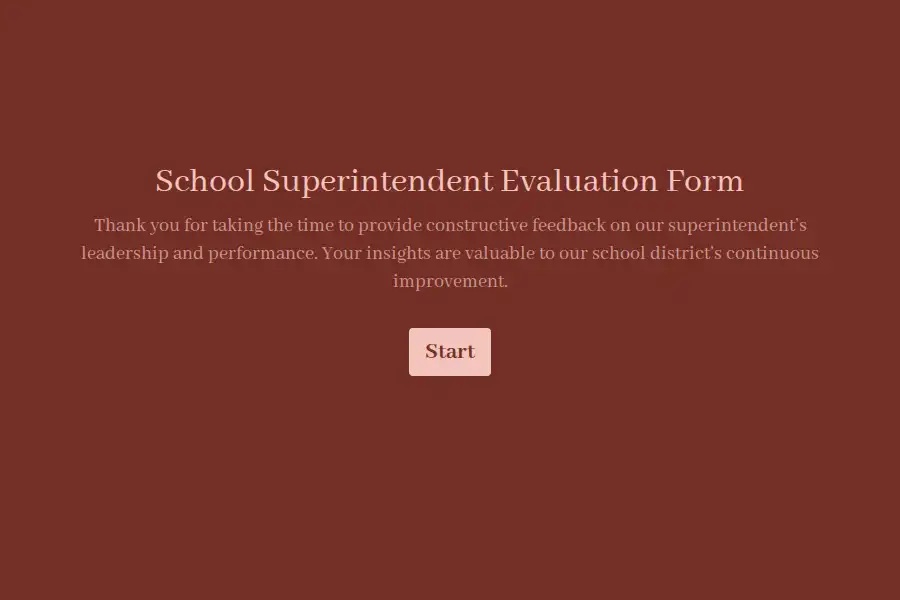

School Superintendent Evaluation Form Template
School boards require a structured, legally defensible, and objective approach to evaluate superintendent performance. Relying on unstructured discussions or informal reviews makes it difficult to track long-term progress, document performance trends, or establish clear leadership benchmarks. A standardized digital evaluation form ensures that reviews across core performance areas are documented systematically.
This template covers key pillars of educational leadership, including communication transparency, student achievement support, resource management, and community relations. It allows boards to collect input from board members, staff, and other key stakeholders, organizing the data into clear actionable feedback.
Core Performance Areas Evaluated
This evaluation form is organized around key dimensions of district governance and operational management:
- Evaluator Context: Tracking the respondent’s relationship to the district and their level of familiarity with different school levels (elementary, middle, or high school).
- Overall Leadership Rating: A high-level assessment of the superintendent’s general performance and executive leadership.
- Communication Effectiveness: Rating how clearly the superintendent communicates district goals, policy changes, and board decisions.
- Academic Support: Evaluating initiatives aimed at student achievement, educational excellence, and equitable learning standards.
- Resource and Budget Stewardship: Assessing financial planning, resource allocation, and budget management across the district.
- Community Responsiveness: Evaluating how effectively the superintendent responds to concerns raised by staff, families, and community members.
- School Culture: Measuring efforts to foster a supportive, professional, and positive working and learning environment.
- Qualitative Feedback: Capturing detailed observations of strengths, areas needing improvement, and specific supporting examples.
- Follow-Up Management: An opt-in field allowing respondents to request further contact regarding their feedback, with secure email collection.
Best Practices for Board Evaluations
To ensure a fair, helpful, and productive evaluation process, school boards should consider the following guidelines:
- Establish Clear Evaluation Intervals: Conduct formal evaluations annually, with a lighter mid-year progress review to ensure goals remain aligned.
- Ensure Consistent Standards: Use the same evaluation criteria for each review cycle to measure progress over time accurately.
- Aggregate Feedback Securely: Collect individual evaluations digitally to prevent bias, aggregating the scores before presenting a synthesized report to the superintendent.
- Balance Numbers with Context: Ensure that numeric rating scales are supported by open-ended comment fields so the superintendent understands the context behind the scores.
Frequently Asked Questions
Who should complete the superintendent evaluation form?
This form is primarily designed for school board members. However, it can also be distributed to district staff, principals, and community partners to gather a multi-stakeholder view of district leadership.
Can this form be used to satisfy state evaluation requirements?
Yes. The evaluation criteria can be adjusted to align with the specific performance standards, legal metrics, and compliance guidelines mandated by your state or regional education authority.
How are rating scales interpreted in the final report?
Numerical rating scales and opinion scales provide quantifiable benchmarks. These ratings make it easy to track performance trends across multiple years and compare scores across different operational areas.
Is it possible to collect follow-up contact information securely?
Yes. The template includes a section where evaluators can opt-in to be contacted for follow-up and provide their email address, allowing board chairs to follow up on specific feedback when necessary.