
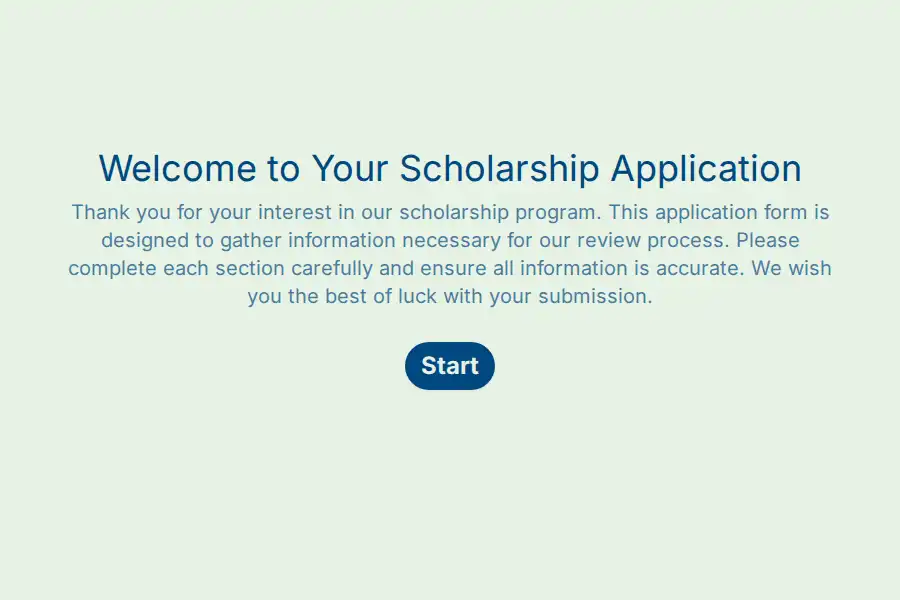


Scholarship Application Form
Selection committees make their best decisions when every file tells its whole story in the same order: who the student is, what they have achieved, what they need, and the evidence behind each claim. They make their worst decisions when files arrive in eleven formats, essays hide in attachments, and the loudest recommender’s letter substitutes for the strongest candidate’s file.
This scholarship application form assembles the complete evidence file — and builds in the structural safeguards that keep evaluation fair when the stakes are high and the committee is reading its fortieth application of the evening.
The Four Layers of a Complete Evidence File
Committees trust files where every claim has a source. The form organizes that principle into layers:
Identity and enrollment basics. Name, institution, year of study, program — the structured contact and academic fields every file opens with. Keep this section compact; it is context, not evidence.
Verified numbers. GPA and enrollment status as structured fields — self-reported here, verified by the transcript that accompanies them. Numbers without documents invite rounding in the student’s favor; documents without structure invite committee guesswork. The pair is the standard.
The applicant’s own words. Prompt-driven long text questions with word guidance stated in the label produce comparable, focused essays — one on goals, one on impact, one on why this award matters now. Vague prompts produce vague essays; specific prompts produce the raw material committees actually differentiate on.
Third-party voices. Transcripts and recommendation letters attached via file upload, with a filename convention suggested in the question so files stay matched to candidates. A closing legal certification — the applicant confirms everything submitted is true — completes the file’s chain of accountability.
Designing for Blind Review
Bias enters committee rooms through names, schools, and neighborhoods — predictably, measurably, and without anyone intending it. The structural countermeasure is blind review: essays and achievements read and scored stripped of identity, with names revealed only when finalists emerge.
The form makes this discipline practical rather than aspirational. Keep identity fields in their own section, separate from the evidence. Where your committee wants stricter separation, review from a renamed duplicate of the form whose response view excludes contact fields. Neither measure is difficult; both measurably change outcomes for applicants from less-famous schools — which is the point.
Reading Forty Files Without Losing the Thread
Structured intake pays its dividend at reading time: every file in one dashboard, essays in comparable formats, evidence attached where claims are made. Committees export, score against their rubric, and finish evenings earlier than the attachment-archaeology alternative. A confirmation email closes the loop with applicants — received, timeline, decision date — which reduces the follow-up emails that otherwise interrupt reading week. Related educational formats sit under the education templates category.
Frequently Asked Questions
What belongs in a scholarship evidence file?
Four layers: identity basics, verified numbers with transcripts, the applicant’s essays, and third-party letters. Committees trust files where every claim has a source — the form’s job is making that standard automatic rather than aspirational.
How long should scholarship essays be?
Long enough to say something, short enough to read twenty: 300 to 500 words per prompt is the working range. State the expectation in the question label so applicants plan — and so the committee’s stack stays readable at midnight.
Should recommendation letters come through the applicant?
Usually yes — the applicant attaches letters with the application, keeping each file self-contained for offline reading. For high-stakes awards, a verification email directly to referees adds confidence without slowing intake. What committees should avoid is letters arriving through a separate channel they must manually re-attach.
How does blind review work with a form?
Structurally: evidence and essays live in sections separate from identity; reviewers read and score anonymized content first; identities are revealed only at shortlisting. The form’s layout enforces the discipline that good intentions alone never sustain.
What do we do about borderline files?
Decide the tie-breaker before reading begins — an essay re-read, a referee follow-up, a stated preference for impact over polish. Committees that choose tie-breakers in advance make consistent decisions; committees that improvise them make defensible ones only by luck.