
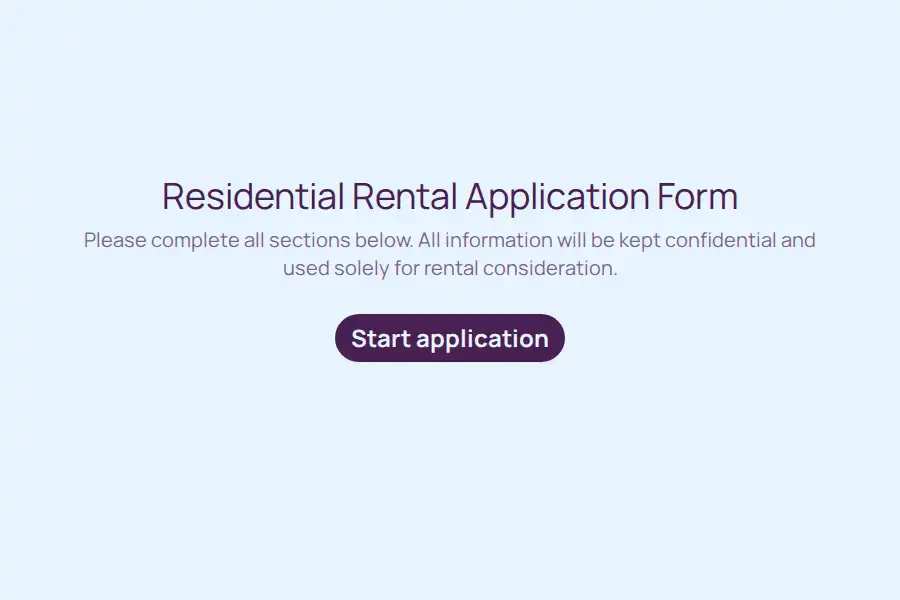
Residential Rental Application Form Template
Ask a private landlord how applications arrive and the answer is never a form. It’s a phone call taken during the school run, a text containing a photo of a passport, an email thread where the income documents surface in the third reply, and a sticky note with a reference’s name that will mean nothing in a week. Every applicant’s story ends up scattered across five channels — and comparing candidates becomes archaeology. This application form consolidates each story into one complete file, collected once, structured identically, ready to review.
One Applicant, One File
The principle is simple and unforgiving of the old way: everything you know about an applicant lives in a single submission. No reconstructed context, no which email was that in?, no promising candidate lost because their file was really four fragments in four inboxes.
The File, Chapter by Chapter
A complete residential application tells a story in six parts:
- Who they are — name and contact details that actually reach them
- Where they live now — current address and what happens to that tenancy when they move
- How the rent gets paid — employment and income, declared by the applicant at this stage and verified for the shortlist
- Who’s coming with them — the rest of the household, including pets
- Where they’ve rented before — previous addresses with named landlord contacts, so verification has targets rather than mysteries
- The paperwork — ID and income documents uploaded into the same submission, attached to the story they belong to
Built for Comparison, Not Just Collection
Collection was never the hard part — comparison is. Identical structure per applicant turns your shortlist review from anecdote into analysis:
- Lay the submissions side by side — same fields, same order, every candidate
- Decisions get made against the file, not against whoever’s phone manner sparkled
- The documented, consistent process doubles as your evidence of fair treatment if a declined applicant ever asks why
Handing the File to Verification
A complete file makes verification fast, because everything verification needs is already in place: every reference contact named, every document attached, every declaration dated. Verify directly — call the previous landlord named in chapter five, check the payslips attached in chapter six — and pass anything requiring formal reporting to your screening provider with the file attached. Submissions can flow onward into whatever system the next stage lives in, without retyping a line.
Access and Care
These files contain exactly the information identity thieves prize. Keep them visible only to the people who need them, retain them for the period your local rules require, and dispose of them deliberately rather than letting them gather forever in a downloads folder. Applicants notice what happens to their documents — and so do their references.
If you’re assembling the wider pipeline, the rental application collection covers the earlier filtering stage, screening workflows, and shared-housing variations.
Frequently Asked Questions
What actually makes an application file complete?
Three things present and nothing outstanding: full contact and history details, self-declared income with documents attached, and named reference contacts. If you could phone every verifier and check every document without contacting the applicant again, the file is complete.
Do I still need to verify what applicants tell me?
Yes — the file organizes claims; it doesn’t certify them. Income figures get checked against documents, references get called, identity gets confirmed against what was uploaded. The complete file doesn’t replace verification; it makes verification something you can actually finish in an afternoon.
Can I use the same form for a flat and a house?
Yes — add a property field, or duplicate the form per vacancy if the properties differ enough to warrant separate question sets. The core chapters rarely change; the property-specific details ride on top.
How should completed applications be stored?
In the platform, with access limited to whoever’s involved in the decision, and exported only when needed. Set a retention period that matches your local requirements — applications from unsuccessful renters shouldn’t sit accessible for years out of inertia.
What if an applicant won't provide a previous landlord reference?
Ask why — there are legitimate answers (a first tenancy, a family sale, a landlord who’s ceased contact) and informative ones. Where a reference genuinely can’t exist, substitute an alternative: an employer contact, longer bank statements, a guarantor. What matters is that the gap is explained in the file rather than discovered after move-in.