
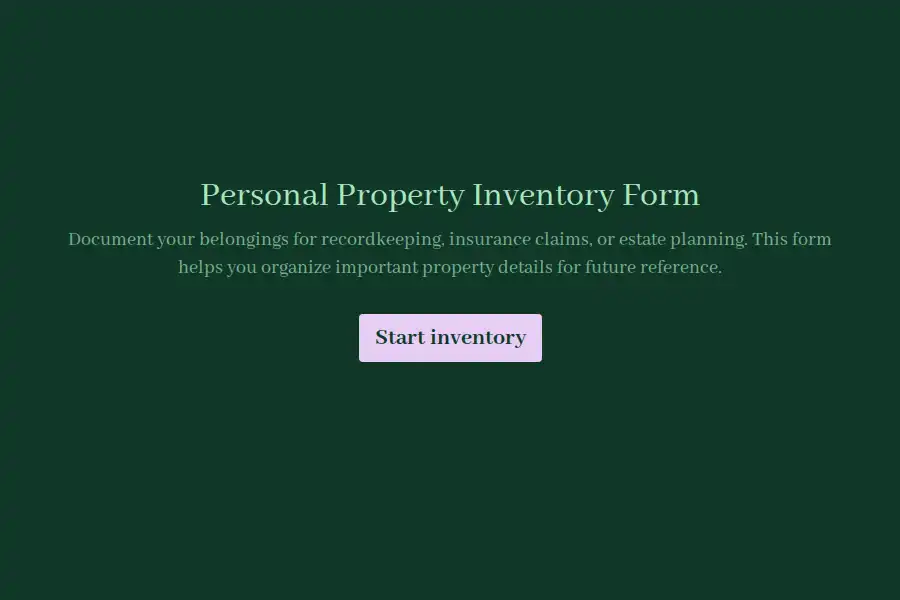
Personal Property Inventory Form Template
Settling a home or renters insurance claim after a fire, water damage, or burglary depends entirely on what you can prove you owned. Trying to recall every item, appliance, and electronic device from memory weeks after a loss is incredibly challenging, and leaving valuable items off your claim forms means missing out on complete compensation.
This personal property inventory form template helps you systematically document your belongings room-by-room while they are right in front of you, generating a organized, detailed record of your assets before you ever need to file a claim.
Why Pre-Loss Asset Documentation is Crucial
Most homeowners and renters do not have an accurate record of their personal property. Creating an inventory using a structured digital form offers significant protection:
- Speeds Up Claims Processing: Providing insurance adjusters with an itemized, documented list of assets cuts down on validation steps and accelerates payout times.
- Verifies True Ownership: Attaching purchase dates, serial numbers, and photo receipts makes ownership unquestionable for high-value items.
- Prevents Undervaluation: Documenting brand names, models, and precise estimated values ensures you receive fair replacement values rather than standard depreciated estimates.
Essential Fields for Asset Tracking
This template is designed to cover personal property data thoroughly and logically:
- Owner & Location Identifiers: Captures your name, email, the primary purpose of the inventory (e.g., insurance, estate planning, moving), the property type, and the physical address.
- Room-by-Room Organization: A multi-select field allows you to clarify which specific rooms or areas of the property you are currently documenting (such as the living room, kitchen, or home office).
- Itemized Details: Collects the item or category name, brand/model numbers, purchase date, and estimated replacement value.
- Digital Proof Uploads: Features a file upload field where you can attach photos of the item itself, warranty documentation, or purchase receipts up to 10MB in size.
- Workflow Flow: Includes a simple yes/no selector indicating whether you want to add another item, keeping the process moving forward systematically.
Best Practices for Maintaining Your Property Inventory
To ensure your records remain highly accurate and useful, consider these guidelines:
- Document High-Value Items Thoroughly: Focus heavily on electronics, jewelry, artwork, and tools. Make sure to capture serial and model numbers, as these are critical for high-value claims.
- Store Records Safely Off-Site: Paper lists and local computer files can easily be destroyed in the same event that damages your property. Storing your inventory data securely in a cloud-based account ensures you can access your records anytime, from any device.
- Update Your Records Annually: Set a reminder to review and update your inventory list once a year, particularly after holiday periods or major purchases.
Frequently Asked Questions
What is a personal property inventory form?
A personal property inventory form is a digital tool used to record details of your physical belongings—including descriptions, brands, estimated values, purchase dates, and receipts—to establish proof of ownership for insurance or estate planning purposes.
Why should I use a digital form instead of a paper list?
Paper lists can easily be lost, damaged, or stolen during a property emergency. A digital inventory stores your entries securely in the cloud, allowing you to access details, photos, and PDF receipts from anywhere during a claim process.
Can I upload multiple files or photos for a single item?
Yes. The file upload field supports attachments up to 10MB, allowing you to upload clear photos of the item alongside digital copies of receipts, appraisal certificates, or warranty documents.
What qualifies as proof of purchase in an insurance claim?
While a retail store receipt is the gold standard, credit card statements, bank records, appraisal certificates, product manuals, and clear photos of the item with its serial number visible are also widely accepted by insurance adjusters.