
Mental Health Survey
Organizations guess about mental health, and their guesses are expensive. The employer that assumes workload is the problem and funds a resilience workshop while the actual driver is fear of asking for help has wasted the budget and missed the problem. The university that runs one wellness week and calls it a program has measured nothing. Group-level mental health work fails for one predictable reason: decisions get made on assumptions instead of data — because collecting the data honestly seemed impossible.
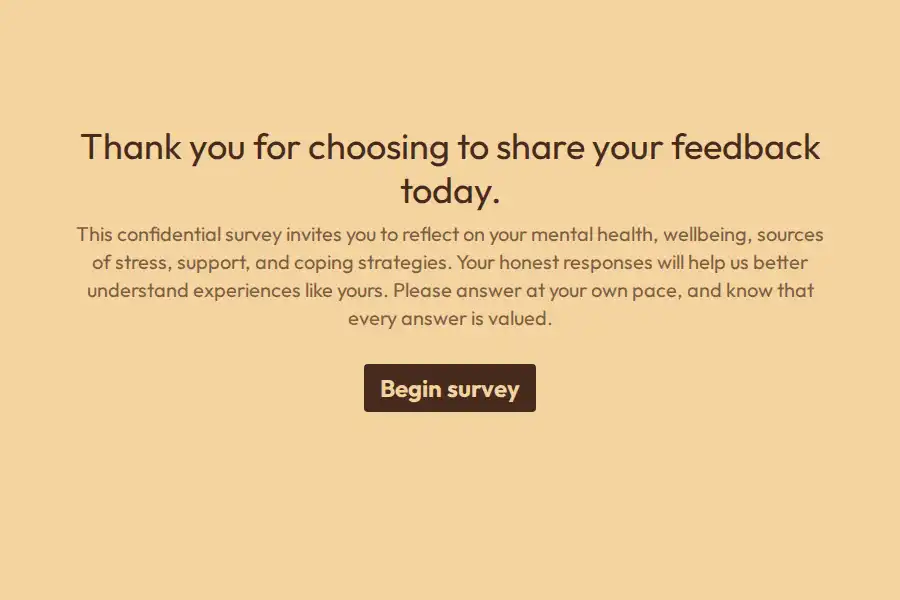
This mental health survey form makes it possible. It is a population-level research instrument: anonymous by design, structured for comparison across a group, and built around the questions that matter to a community’s actual wellbeing — what is stressing people, who feels supported, what stops them from seeking help, and what would actually help. Delivered once or on waves, its purpose is a report, not a chart: findings that direct real decisions about resources, programs, and stigma.
Anonymity Is the Methodology
For population mental health research, anonymity is not a preference; it is the validity condition. Nobody answers honestly about stigma while their name sits in a field — fear of professional consequence silences precisely the respondents whose answers matter most. The template enforces anonymity structurally: no name, no identifier, no account, results visible only in aggregate. Where follow-up matters — resource distribution, focus-group recruitment — a single optional email field invites it without requiring it, keeping the anonymity default intact.
Structural anonymity has a second benefit organizers underestimate: it changes what respondents will say. Anonymous surveys surface the stigma itself — the share who would not feel comfortable seeking professional help, and the reasons why — which named surveys never collect, because the act of naming identifies the very admission the survey needs.
Measuring the Group, Not the Individual
The survey’s fields are chosen for aggregate meaning:
- Self-reported wellbeing and stress frequency — rated on scales identical for every respondent, so group averages are real averages
- Primary stressors — work, family, health, finances — captured in a multiple choice battery that ranks the community’s actual pressures
- Support networks — whether people have someone to talk to, and whether they have recently spoken to anyone about their mental health
- Coping and care comfort — what people currently use to cope, and how comfortable they would feel seeking professional care: the stigma measurement
- Barriers to help-seeking — cost, access, stigma, time, not knowing where to start: the section that directs program design
- What would help — an open field for what the community says it needs, which routinely diverges from what organizers assumed
Every field answers to the aggregate: no individual’s answers drive a decision, and every individual’s answers shape it.
Barriers and Stigma: The Section That Directs Budgets
The survey’s highest-value section is the one most organizations skip: why don’t people seek help here? A structured multiple choice battery captures the barrier landscape, and a comfort-scale question measures how safe people would feel seeking professional care. Together they tell an organizer exactly where the problem lives: a community with low barriers but low comfort needs anti-stigma work; a community with high comfort but high cost barriers needs resource navigation. Without this section, wellness budgets address guessed problems — the program that assumed workload and learned the real barrier was fear of being seen asking for help now funds manager training, not resilience workshops. That is the survey doing its job.
The survey can live on the organization’s wellness page as a standing instrument, distributed through internal channels or community networks. Because it reads as research rather than administration, the tone stays neutral and non-judgmental throughout — people participate in studies; they submit to programs.
From Responses to a Report
All responses accumulate in one reviewable view for aggregate analysis — filterable by the group segments the organizers define, exportable for the report. With webhooks, responses can flow into analysis spreadsheets as they arrive, and the survey can close automatically at the wave’s end to define the study period cleanly. Crisis resources display visibly at the survey’s end — population research about mental health carries the same obligations as any mental health instrument, even anonymously. Related research formats are collected under survey templates.
Frequently Asked Questions
How is this population survey different from a clinical assessment?
Unit of analysis and purpose. The clinical assessment serves one individual’s care, reviewed by a professional, feeding diagnosis and treatment. This survey measures a population: anonymous, aggregate-only, and feeding organizational decisions — program design, resource allocation, stigma initiatives. One produces a treatment plan; the other produces a report that directs budgets.
Should the survey be fully anonymous?
Yes — structurally, not by request. No name fields, no identifiers, aggregate-only reporting: anonymity is the validity condition for honest answers on stigma and barriers, and the barriers section is where the survey’s value concentrates. Optional email for resource distribution is fine; mandatory identification would invalidate the data.
How is this different from a wellness survey?
The question beneath the question. A wellness survey asks how healthy is the group and what program fits — lifestyle-focused, program-design oriented. This survey asks what is driving distress and what stops people from getting help — stressors, stigma, support networks, care barriers. One informs a program calendar; the other informs a mental health strategy.
How often should a population survey run?
Annually for strategy-level measurement, or in waves that track the effect of interventions: baseline, program, re-measure. Whatever the rhythm, keep the instrument identical across waves — population trends are only as good as the consistency of the questions producing them.
Should crisis resources appear in a survey?
Yes — visible at the end, alongside the statement that the survey is not an emergency channel. Population research still collects from individuals, some of whom will be struggling while they answer. The obligations do not stop at the aggregate; the care shows in the design.
What do we do with the findings?
Act on them visibly. Publish what the group said, what the organization will do about it, and when — because the next survey’s honesty depends on this survey’s consequence. Communities that see their answers change things answer the next survey honestly; communities that see no change answer it with whatever they think the organizers want to hear.