


The Benefits Administrator’s Program Problem
An organization rarely runs one medical benefit. It runs an HRA with its own eligible-expense list, an FSA with its own substantiation rules, a dental allowance, a vision allowance, and a wellness stipend someone added last spring — each with different limits, different evidence, and different reviewers. Employees, naturally, submit everything to everything.
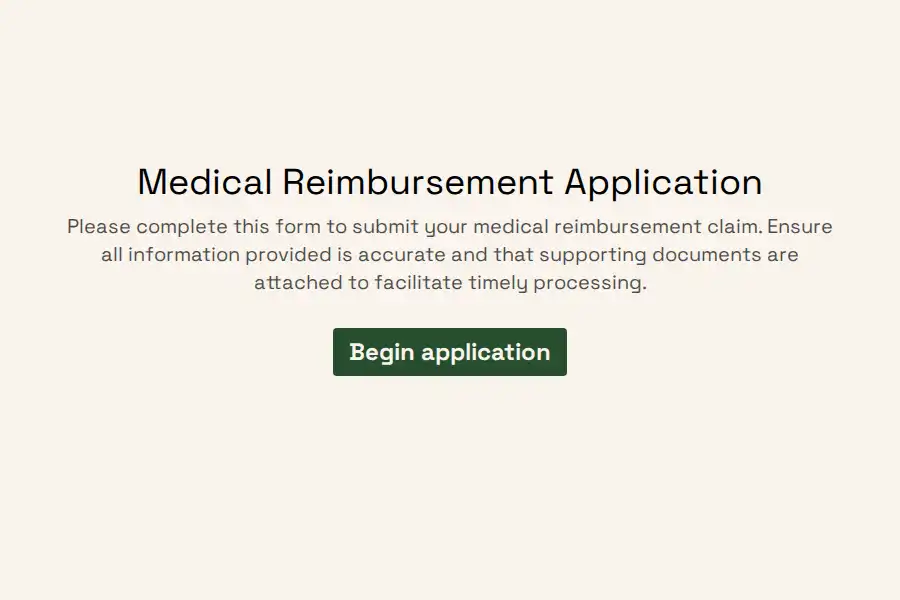
This application form is built for the program portfolio: one intake that asks which benefit is being claimed first, then walks the employee through that program’s specific requirements — and gives the administrator clean, per-program queues instead of a single undifferentiated pile.
Start With the Program, Not the Expense
A multiple choice question opens the form: which benefit is this claim against? The answer does the routing — HRA claims surface the employer-plan questions, FSA claims surface the substantiation requirements, dental and vision claims surface their allowances. Employees never see questions belonging to programs they are not claiming against, which is both a courtesy and a compliance posture: each program’s intake asks only what that program’s rules actually require.
The Expense, and Its Evidence, Kept Separate
Program rules differ; the discipline underneath them is constant:
- The expense record. What was purchased, from whom, on what date, for how much — structured fields that feed the program ledger.
- The substantiation. The itemized receipt or provider statement attached via document upload — the document that proves the expense, carried with the application rather than hunted down later.
- The declaration. A legal-style acknowledgment in the program’s own language: the expense is eligible under the plan as the employee understands it, the documents are authentic, other coverage has been declared.
Program administrators rewrite the declaration per program — that text belongs to the plan document, not to a template.
One Master, Many Programs
Build the shared spine once — identity, expense record, evidence, declaration — then duplicate the form per program and adjust only what the plan rules change. Each program gets its own link, its own queue, and its own paper trail; a changed FSA rule updates one copy without touching the HRA. Category-level variants (dental versus vision) can live as branches in one form or as separate forms — whichever matches how the team actually works.
Frequently Asked Questions
What is the difference between an HRA and an FSA claim?
Funding and ownership: an HRA is employer-funded with employer-defined eligible expenses; an FSA is an employee salary-reduction account governed by its own substantiation rules. The claim mechanics are similar; the eligible-expense lists and the declaration language are not — which is why the program question routes them apart.
What happens when an expense is not eligible under the program chosen?
The reviewer declines the claim with the reason — and where another program might cover the same expense, redirects the employee rather than leaving them to guess.
Does submitting an application guarantee payment?
No — submission starts the review. Eligibility follows the plan document, the substantiation attached, and the administrator’s determination.
Can one form serve every program at once?
Small benefit portfolios can, with the program question routing branches. Once programs diverge sharply in rules and reviewers, per-program copies stay cleaner — and the duplicate workflow makes that a five-minute decision.