
Health Self-Assessment Quiz
Health is mostly a spreadsheet nobody looks at. Sleep hours, water glasses, movement sessions, vegetable servings, energy across the day — the numbers exist, the patterns exist, and almost nobody ever assembles them into a picture. The weeks blur, habits drift, and the first structured look typically happens at a doctor’s office, two years into whatever has been drifting.
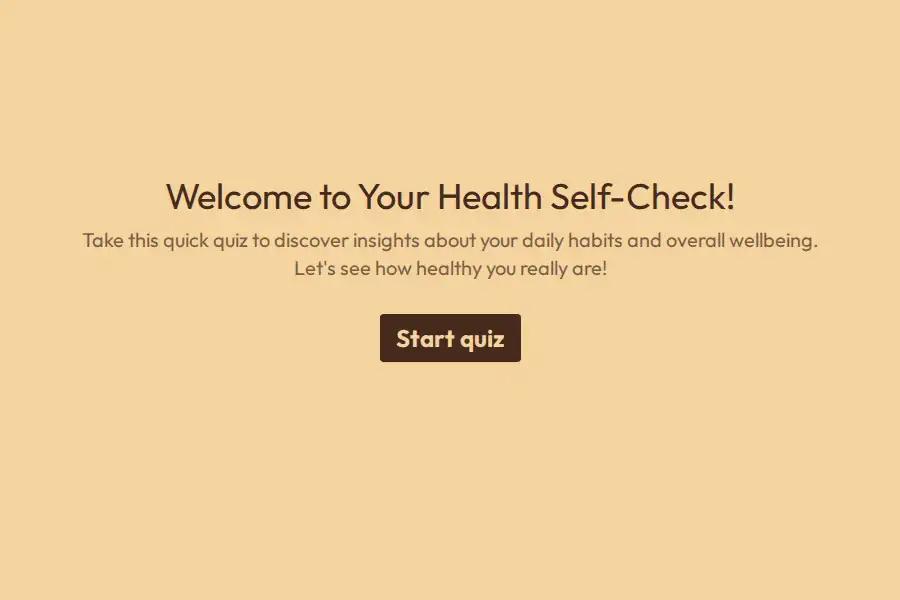
The health self-assessment quiz is that structured look, moved to where it can change something: five minutes, the person’s own device, their daily habits laid out in front of them. No clinician reviewing it, no chart to enter — a whole-life audit whose deliverable is the person’s own awareness, and — where a coach or wellness program sits on the other end — the preparation file that makes professional guidance land from the first conversation.
The Whole-Life Battery
The quiz audits the daily habits wellness actually runs on, each captured in quick, non-judgmental format:
- Sleep — quality over the past week on a simple scale, because sleep quality is the multiplier on every other habit
- Hydration — daily water intake, the habit everyone knows and nobody tracks
- Movement — weekly exercise frequency plus daily activity, structured so the number is comparable later
- Nutrition — fruit-and-vegetable frequency plus an eating-pattern multiple choice: the dietary sketch without a food diary
- Stress — current level on a visual rating scale, the summary variable for the whole audit
- Energy — consistency across the day, the lived output of everything above
- Recovery habits — tobacco and alcohol frequency, plus whether the person actually makes time for enjoyable activities — the section people skip and coaches need
The design discipline is speed: quick scales and multiple choice throughout, five minutes end to end, mobile-first — because the person completing this is doing it in a spare moment, and the audit that takes effort is the audit that never happens. A progress bar keeps the five-minute promise visible from the first screen.
Awareness, Not Verdicts
The tone discipline mirrors the best self-reflection instruments: no scores, no rankings, no verdicts. The deliverable is the person’s own map — their habits honestly assembled, many for the first time. For many completers, seeing the pattern is the intervention: the person who notices their energy crashes map onto hydration, or that their stress rating and sleep rating have been moving together for months, has already done the work of a dozen wellness articles.
That is why the quiz ends with awareness rather than instruction: a supportive ending screen — built with the customized ending tools — that validates the act of checking in, reflects the person’s own picture back, and offers one small, doable change. The scale of the ask matters: behavior change fails at the scale of everything and succeeds at the scale of something.
The Coach’s Preparation File
Where the quiz is deployed by coaches, wellness brands, and health programs, its second audience appears: the professional who receives the completed assessment as preparation. A health coach receiving a client’s quiz before the first consultation starts the session from the client’s own reported baseline instead of spending the appointment reconstructing it. The habit numbers become the coaching plan’s inputs: which habit to work on first, what the client already does well, what the small changes should be.
This is the structural line between this instrument and a clinical assessment: the professional receiving it is a coach or wellness professional using it for planning and fit — not a clinician using it for evaluation. The scope stays self-reflection; the professional’s use is preparation, not diagnosis.
Deployment Across the Wellness Ecosystem
The quiz distributes wherever wellness engagement happens: coaching and wellness brands send it at booking or embed it on the booking page as the first touch of a coaching relationship; corporate wellness programs offer it to employees as an individual self-audit under the same anonymity rules as any self-directed instrument; health websites and creators share it via link as engagement content that provides genuine value rather than a lead form in disguise; and community wellness events run it from a QR code at the booth, the audit as the event’s takeaway.
For programs that want later re-audits comparable to intake, recall information brings the person’s original answers forward — the twelve-week re-audit opens with their starting habits beside their current ones, the most persuasive progress conversation a coach can facilitate. The aggregate lane — group patterns that direct program design — belongs to the wellness survey, and organizations running both keep the instruments in their lanes: the quiz for individuals, the survey for the population. Related self-directed formats are collected in the engage audience templates category.
Frequently Asked Questions
Is this quiz a medical tool?
No — and the disclaimer appears at both the start and the end. It is a structured self-reflection instrument for personal awareness and professional preparation. It does not diagnose, does not enter charts, and does not replace medical advice. Clear limits are what make self-reflection tools responsible.
How is this different from the lifestyle & weight assessment quiz?
Breadth versus depth. The weight assessment goes deep on the weight-health pathway — nutrition detail, dieting history, family history, clinical bridge. This quiz audits the whole daily-life map — sleep, hydration, movement, nutrition, stress, energy, recovery habits — and ends at the person’s own awareness and their coach’s preparation. One goes deep toward clinical awareness; the other goes broad for personal insight.
Can employers use it with their teams?
Carefully, and individually — employees complete it as their own self-audit, not as data collection. Where an organization wants group patterns, that is the wellness survey’s lane, run anonymously in aggregate. Keeping the individual instrument and the population instrument separate protects both the individual’s privacy and the employer’s information posture.
What belongs on the results screen?
Validation, the person’s own habit picture reflected back, one small doable change, and — where medical concerns surfaced — visible guidance toward professional care. No scores, no rankings, no alarm. The moment after a self-audit is delicate; the ending screen is the instrument’s most important screen.
How often should someone re-take it?
Quarterly is the working rhythm for self-monitoring, or aligned to coaching cycles. Because the questions repeat identically, re-audits compare cleanly — and with recall information, the re-audit opens with the person’s original answers beside the current ones, which turns self-monitoring into a visible trajectory rather than a feeling.
How long does it take?
Five minutes, deliberately. It competes with a spare moment, not a calendar slot — and its honesty depends on staying below the effort threshold where an audit becomes an assignment.