


Georgia’s Rules Are Simple. The Prep Still Matters.
Compared with most states, Georgia makes marriage licenses refreshingly painless: no waiting period, no blood test, no residency requirement, and a license issued by any county’s Probate Court that’s valid for a ceremony anywhere in the state. What Georgia doesn’t simplify is the logistics: every one of its 159 counties operates its own Probate Court, each with its own hours, appointment policies, and form quirks — and both applicants must appear together, in person, no exceptions.
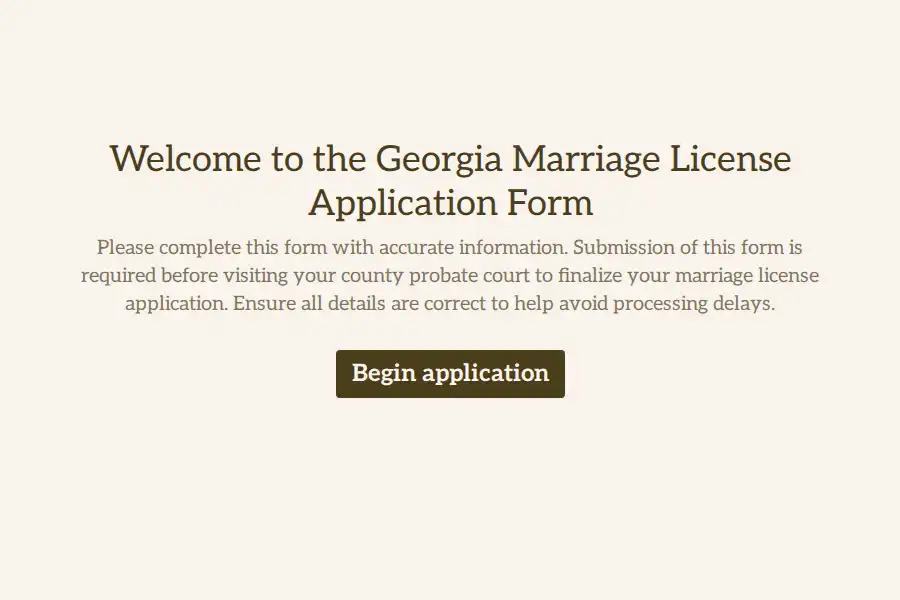
This Georgia marriage license application form template exists so that the courthouse visit is a formality. Couples complete the application online first — particulars, prior-marriage disclosures, county selection, the counseling certificate that cuts the fee — and walk into the Probate Court already approved-able.
The Ground Rules, Briefly
Worth stating plainly at the top of any Georgia application flow: both applicants appear together in person; proxy applications aren’t permitted. Both must be of legal age — 18 — and Georgia’s earlier provisions for younger applicants with court involvement are gone. There’s no blood test and no waiting period, so a couple can obtain their license and marry immediately after; the only genuine constraint is the courthouse’s own operating hours, which vary by county and are worth checking before planning a same-day ceremony.
Apply Wherever Suits You — the License Travels
Georgia issues licenses county by county, but honors them statewide: a license from any Probate Court works for a ceremony anywhere in Georgia. That freedom is exactly why the form opens with a county dropdown — let couples choose the office that fits their schedule rather than defaulting to the county they live in, and have the confirmation materials point them at that specific court’s hours and requirements.
What the Application Asks Both Applicants
The Probate Court application wants consistent particulars from each applicant: full legal name, date of birth, place of birth — Georgia asks for it on both — and current residence. Prior marriages come next: many counties ask how any previous marriage ended, so the form includes a yes or no disclosure per applicant with fields for the details. Social Security numbers are collected under Georgia’s process, with an affidavit route for applicants who don’t have one; capture them in your office’s secure workflow, never in anything that circulates.
The Fee Cut Most Georgia Couples Miss
Here is the detail that pays for the whole form: Georgia law entitles applicants to a substantially reduced license fee when they’ve completed premarital counseling — typically six hours with a qualified counselor such as clergy, a licensed therapist, or a designated counselor provider. Most counties charge the standard fee without it and a fraction of it with the certificate; the difference is real money, and thousands of couples pay it without knowing. The form captures whether the couple completed counseling and accepts the completion certificate as an upload, so the reduced fee is claimed at the counter rather than discovered afterward. Exact amounts are set by each county — have couples confirm with their chosen Probate Court.
After the Ceremony
Georgia completes the record through the officiant: the person who solemnizes the marriage files the completed license with the issuing Probate Court, which then produces the official certificate. For everything a new marriage triggers next — Social Security, the DMV, a passport in a new name — the certified copies come from that same court, and the application’s confirmation can tell couples this in advance so ordering copies isn’t an afterthought. Pair this application with your event registration workflows for the ceremony side, and the broader event planning library for everything around it.
Frequently Asked Questions
Where do we apply for a Georgia marriage license?
Any county Probate Court — you are not restricted to where you live, and the license you receive is valid for a ceremony anywhere in Georgia. Choose the county that matches your schedule; its hours and appointment policy are the real variables.
Is there a waiting period in Georgia?
No. Once the license is issued, you can marry immediately — many couples obtain the license and hold the ceremony in the same week or even the same day, subject only to the courthouse’s hours.
How do we get the reduced license fee?
Complete premarital counseling — commonly six hours with a qualified counselor — and bring the completion certificate. Most Georgia counties reduce the fee dramatically with it. The application collects the certificate in advance so the reduction is applied without a second trip; confirm current amounts with your county.
One of us was married before. Is that a problem in Georgia?
Not inherently — but disclosure matters. Many counties ask how the previous marriage ended, and the application captures those details for both applicants upfront, so the file is complete when you arrive rather than corrected at the counter.
Do Georgia weddings require witnesses?
Georgia generally does not require witnesses for the license — the officiant’s certification is what completes the record — though a handful of counties’ forms still include space for them, and some venues like to have them regardless. Check your county’s form; the application flags where witnesses apply.
What about common-law marriage in Georgia?
Georgia stopped recognizing newly formed common-law marriages for relationships beginning after mid-2019 — existing ones from before then remain valid. For anything current, a license is the path, which is precisely what this application exists to start.