
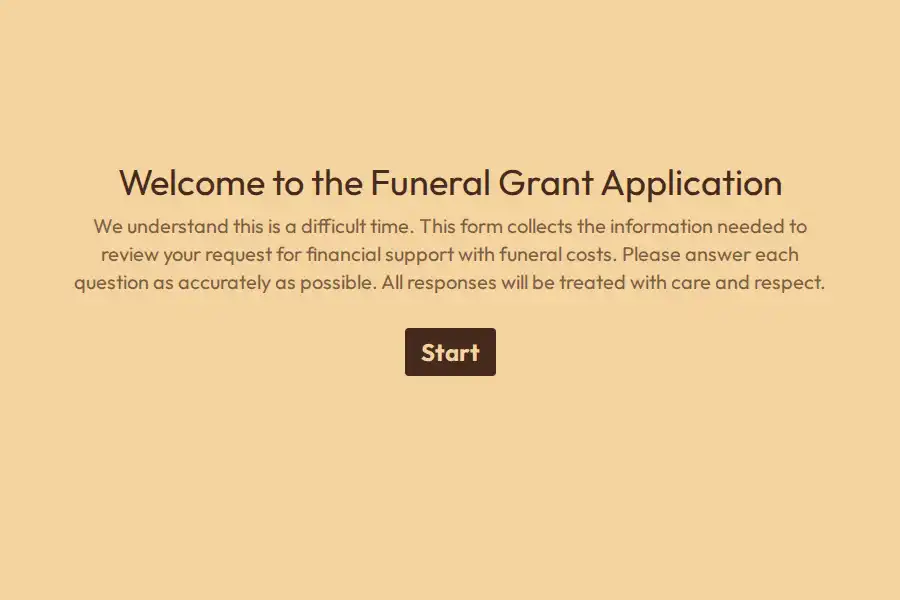


Funeral Grant Application Form
Applying for funeral assistance can be difficult at the best of times. When an applicant is grieving and also facing urgent financial pressure, a confusing application or repeated request for missing information adds unnecessary strain.
A structured funeral grant application gives applicants a clear path through the information an organization needs to assess support. It also gives the reviewing team a consistent record for each request, making it easier to identify missing information and prioritize cases.
Information to collect in the application
The exact requirements depend on the grant program and its eligibility rules. A typical application may cover:
- Applicant name and contact details
- Date of birth or other identifying information required by the program
- Relationship to the deceased
- Deceased person’s name and date of death
- Funeral home or service provider details
- Estimated or confirmed funeral costs
- Household income and financial circumstances
- Existing benefits or support already received
- Supporting documents required for eligibility
- Applicant declaration or electronic signature
Only collect sensitive information that is necessary for the assessment, and make the purpose of required fields understandable to applicants.
Use conditional questions to reduce unnecessary burden
Not every applicant will have the same financial circumstances. Conditional logic can adapt the form based on answers about benefits, eligibility, or other relevant circumstances.
For example, an applicant already receiving a particular benefit may need to provide different details from someone who is not receiving that support. Showing only relevant follow-up questions keeps the application more manageable and reduces confusion.
Make document requirements clear
If applicants need to provide evidence such as a death certificate, funeral invoice, or proof of income, tell them what is required before they begin. Formware’s File Upload feature can collect JPG, PNG, and PDF documents alongside the application, with a 10MB limit per file.
Avoid making applicants guess which document proves a particular requirement. Clear labels and instructions can prevent incomplete submissions and reduce the need for staff to request replacements later.
Help reviewers prioritize applications
Once applications arrive, connect them to Google Sheets or Airtable via Zapier if that fits your organization’s workflow. Key fields such as application date, income circumstances, benefit status, or other eligibility criteria can then be used to organize the review queue.
Email notifications can alert the responsible team when a new application arrives. This is particularly useful where support needs to be assessed promptly, because staff do not have to rely on periodically checking an inbox or manually collecting paper applications.
Keep the applicant experience compassionate and clear
The wording matters as much as the fields. Explain what the application is for, what information is needed, and what happens after submission. Avoid unnecessary jargon and do not make people repeatedly provide information that the organization does not need for its decision.
A one-question-at-a-time format can make a sensitive application feel more manageable. The objective is not merely to collect complete data; it is to make the path to assistance as straightforward as the program allows.
Frequently Asked Questions
What is a funeral grant application form?
It is a structured application used by an organization to collect the information needed to assess a request for funeral financial assistance. Depending on the program, this can include applicant details, information about the deceased, funeral costs, household finances, existing benefits, and supporting documentation.
What information should a funeral assistance application include?
Start with the program’s eligibility requirements and work backward to the information needed to assess them. Common sections cover the applicant and deceased person’s details, relationship to the deceased, funeral costs, household financial circumstances, existing support, required documents, and a declaration. Requirements vary by organization and jurisdiction.
Can applicants upload funeral-related documents?
Yes. Formware’s File Upload feature can collect supporting documents such as death certificates, funeral invoices, or proof of income directly with the application. JPG, PNG, and PDF files are supported up to 10MB per file, and the feature is available on free Formware plan.
How can I make a funeral grant application easier for families to complete?
Keep the questions focused on eligibility and assessment, explain why required information is needed, and avoid unnecessary repetition. Use conditional logic so applicants see only relevant follow-up questions, provide clear document instructions, and explain what happens after submission. A calm, straightforward tone is especially important for bereavement-related applications.
How can an organization review a large number of applications?
Connect submissions to Google Sheets or Airtable via Zapier and organize them using the fields that matter to your eligibility and review process. Notifications can alert staff to new applications. If some cases require urgent attention, establish clear internal criteria for prioritization rather than relying only on the order applications arrive.
Should a funeral grant application collect sensitive financial information?
If financial information is part of the program’s eligibility assessment, it may be necessary. Collect only what the organization needs, explain its purpose, and handle access according to your organization’s privacy and data-handling practices. The application should not request sensitive information simply because it might be useful later.