
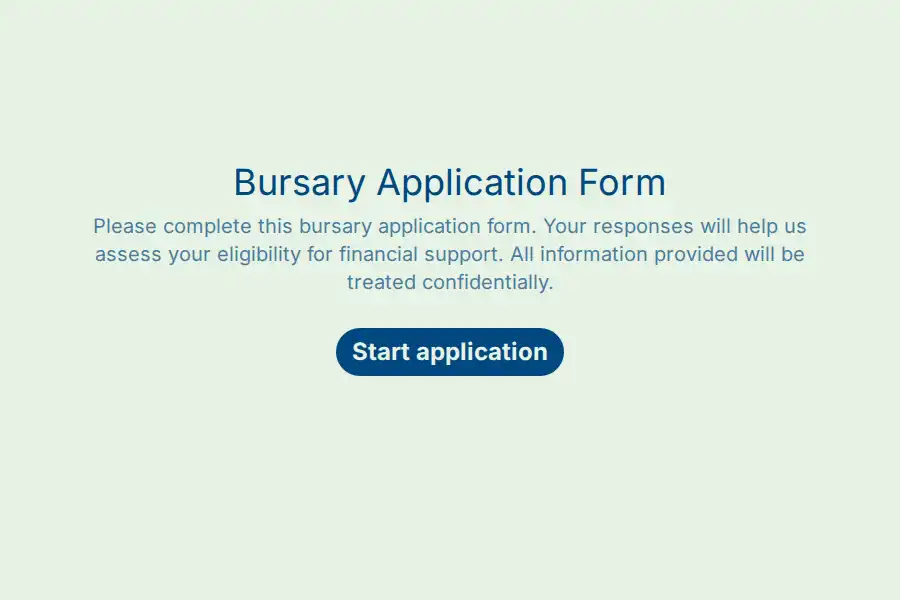
Bursary Application Form
A bursary asks families to document their finances at the most vulnerable moment in their educational journey. The application you build determines whether that moment feels like a process or an interrogation. Get it wrong — demanding precise figures, exposing disclosures to wide access, treating need as suspicion — and qualified families simply do not apply. The funds sit unallocated while the students who needed them most stay away.
This bursary application template is designed for rigorous means-testing that respects the people being means-tested: income ranges rather than salary interrogations, narrative space for context numbers cannot carry, verification handled discreetly, and privacy explained plainly from the first screen.
What Means-Testing Actually Requires
Committees allocating need-based support weigh three things: the household’s financial picture, the circumstances shaping it, and the gap between educational costs and available resources. The form gathers each in its proper register.
Income in bands, not decimals. Selecting a range — under a threshold, between thresholds — is psychologically easier and more honest than typing exact figures, and for allocation purposes the band is what matters. A multiple choice question presents the bands; precision theater adds nothing but discomfort.
Household composition. The number of dependents relying on that income, and major ongoing obligations — medical costs, caregiving responsibilities, housing pressure. Two households with identical incomes can face radically different realities; these fields are where that difference becomes visible.
Existing support. Other aid, grants, or scholarships already in place. A bursary fills the unfunded gap — asking directly prevents accidental double-awarding and shows the committee the true shortfall.
The Circumstances, in the Family’s Words
Numbers identify need; narratives explain it. A long text question inviting the family to describe their circumstances in their own words consistently becomes the most-read field on the form. Recent job loss, a single income stretched across three students, unexpected medical expenses — the context that decides close cases lives here, and no checkbox captures it.
Keep the prompt open and unpressured: invite explanation rather than demanding justification. Families writing to a compassionate prompt write usefully; families writing to an audit prompt write defensively.
Verification Without Intimidation
Where your policy requires evidence — income letters, benefit statements, tax summaries — a file upload field accepts documents directly with the application. Two handling principles matter as much as the mechanism: request only what your awarding rules genuinely require, and explain in the form why each document is needed. Verification requested transparently reads as process; verification requested silently reads as surveillance.
For minor applicants, guardians complete the financial sections — the introduction should address them directly, and the tone should recognize they are disclosing on behalf of their family, not just themselves.
Privacy as a Design Feature
Sensitive disclosure demands more than good intentions. Three practices protect applicants and your institution:
- Restrict access to named financial-aid staff. Submissions should never circulate through shared inboxes or broad dashboards; role-based access keeps views need-to-know.
- State your practices plainly at the top of the form: who reviews applications, how information is used, how long records are kept. Trust, stated and honored, measurably improves disclosure honesty.
- Keep documents with applications, not in separate folders — the response view keeps each family’s file whole and its access contained.
Similar school-based support formats sit under school templates.
Frequently Asked Questions
How is a bursary different from a scholarship?
Scholarships reward achievement; bursaries respond to financial need. The difference shapes the entire form — this one asks about household income, dependents, and circumstances rather than grades and prizes. Where a program offers both, run separate intakes: the questions, evidence, and tone genuinely differ.
Should we ask for exact income figures?
No. Ranges produce more honest answers with zero loss of allocation value — committees decide between bands, not between dollars. Exact-figure questions get skipped or softened out of discomfort, and a skipped question is worth nothing at all.
How much verification should we require?
The minimum your awarding rules genuinely need — often an income letter or benefits statement. Every additional document raises the friction that deters precisely the families bursaries exist for. Verification should confirm the picture, not reconstruct it.
Can parents complete this for adult students?
Household finance belongs to whoever’s household it is. For minors and dependent undergraduates, parents complete the financial sections. Independent adults complete their own. A simple applicant-status question at the top routes the form appropriately.
How do we handle applications that exceed available funds?
Rank by assessed need against your published criteria, communicate timelines honestly in your confirmation messaging, and consider a transparent waitlist with stated priority rules. Silence is the one response that damages trust — families accept difficult outcomes far better than unexplained ones.