
Your First Hire Does Not Need an HR Department
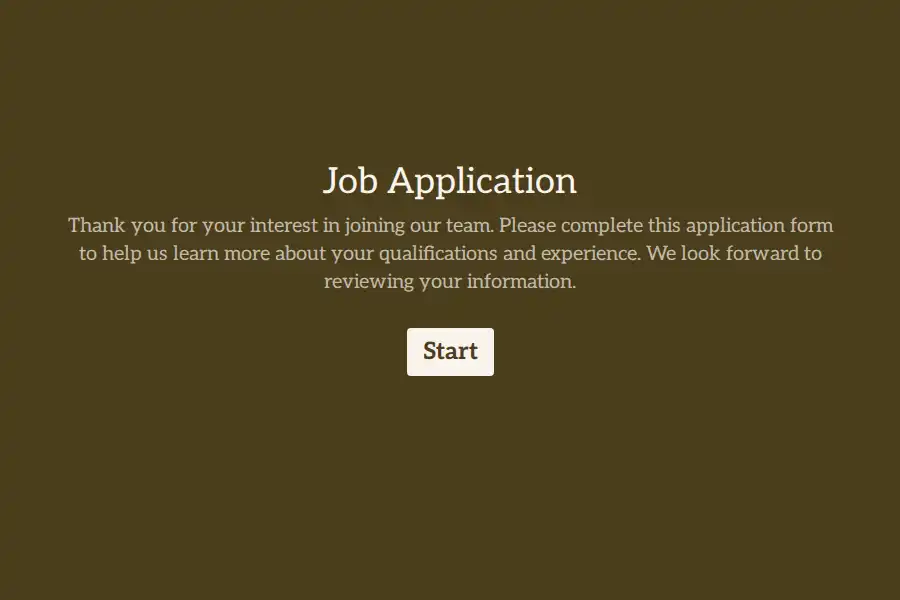
Somewhere in every small business’s life, the ad goes up and the inbox fills. Resumes with no file names, applications in the spam folder, the promising candidate from three weeks ago whose email nobody can find. None of it requires enterprise software to fix — it requires ten good questions on one page, and this template is exactly that: the simplest complete application a first-time hirer can run.
Ten Questions, One Page
Keep the whole thing answerable in five minutes:
- Name and how to reach you — one contact block.
- Which job are you after — a plain short text or dropdown.
- What have you done that fits — a few sentences, their words.
- Where did you work last, and till when — one line each.
- When could you start — a date field.
- Anything we should know about your availability — one optional line.
- The resume — a file upload for those who have one.
- A confirm box — the details are true.
That is the entire form. Candidates finish it on a phone at the counter; you get identical answers from everyone, which turns out to be most of what professional hiring software actually sells.
Getting It Out There
Build takes minutes with the form builder; publishing gives you one link that goes anywhere the ad goes — the job board, the shop window, the community board. Unlike an email address, the link never misfiles anyone.
When Someone Applies
Set the thank-you screen to say what happens next — we go through applications every Friday and call within a week — because small businesses lose good people to silence more often than to rejection. Each application pings your inbox through a self notification, and when fifty arrive for one ad, the responses view lets you sort by availability and start calling in order. When the next hire comes around, the same form is waiting.
Frequently Asked Questions
Is a form overkill for one job ad?
It is ten minutes of setup that saves weeks of lost-email chaos — and it is reusable for every hire after this one.
What must I not ask?
Keep it to the work: nothing about age, family, health, or where they were born. The plain rule for a first-time hirer: if it is not about doing this job, it is not on the form.
Should the ad mention the pay?
Yes — always. It filters out mismatched applications before they cost anyone time, and candidates trust employers who say the number first.
What if I get far more applicants than expected?
That is the structured data earning its keep: sort by the answers, shortlist from the page, and only open resumes for the final few.