
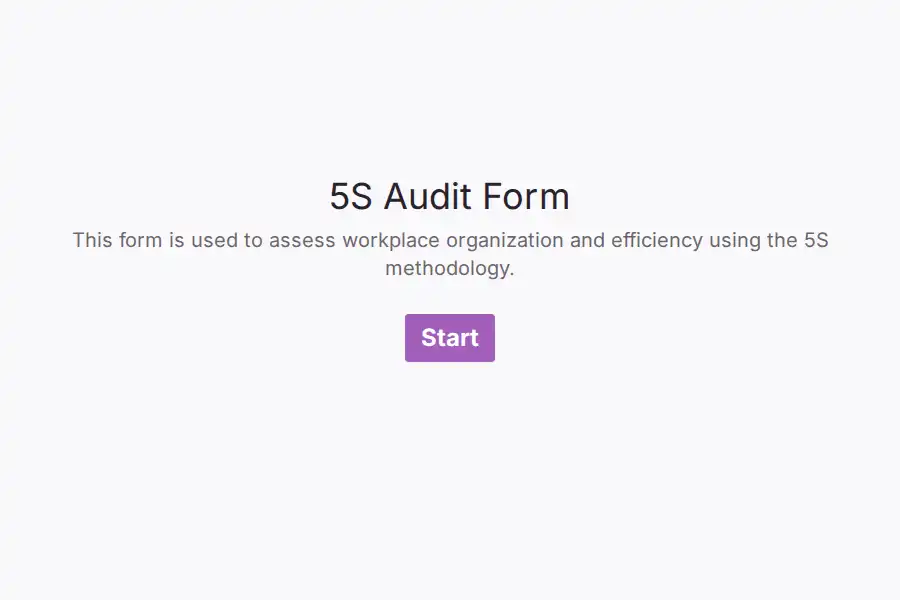
5S Audit Form Template
Sustaining a lean, safe, and efficient work environment requires regular audits that evaluate workplace organization against established operational standards. The 5S methodology—Sort, Set in Order, Shine, Standardize, and Sustain—only works when audits are conducted consistently across shifts, production lines, and departments.
Using a digital 5S audit form ensures that every audit is documented systematically. Auditors can quickly complete checklists, rate conditions, document issues, upload visual evidence, and assign corrective actions directly from a mobile device or tablet on the shop floor.
Key Sections of the 5S Audit Checklist
This template provides a comprehensive framework to assess and document workplace conditions:
- Audit Metadata: Fields to capture the specific site, audited department, the auditor’s name, and the date of the evaluation.
- Pillar Evaluation: Targeted questions assessing the five core lean principles:
- Sort (Seiri): Verifying that only necessary items, tools, and materials are present in the work zone.
- Set in Order (Seiton): Checking that tools and equipment are arranged in designated, labeled locations for easy retrieval.
- Shine (Seiso): Ensuring that the workspace is clean, orderly, and free of dirt, debris, or fluid leaks.
- Standardize (Seiketsu): Confirming that visual standards, labels, and standard operating procedures (SOPs) are clearly displayed.
- Sustain (Shitsuke): Assessing whether 5S habits and routines are followed consistently over time.
- Condition Rating: An overall opinion scale to rate the general 5S status of the audited area.
- Observations & Visual Evidence: A deep-dive text field to describe issues, combined with a file upload field to attach supporting photos or documentation.
- Action Plan: Fields to document recommended corrective actions, assign responsibility to a specific team member, and establish a target completion date.
How to Deploy 5S Auditing Effectively
- Train Your Auditors: Ensure all team leaders and auditors use the same criteria to evaluate each question to maintain scoring consistency.
- Use Photos for Clarity: Encourage auditors to take photos of both excellent organization and areas needing improvement. Visual evidence is highly effective for team huddles and training.
- Track the Follow-Up: An audit is only as good as the corrective action it generates. Review target completion dates weekly to ensure outstanding items are resolved.
- Display the Scores: Share the audit results and trends in team areas to encourage friendly competition and highlight continuous improvement progress.
Frequently Asked Questions
What are the five pillars evaluated in a 5S audit?
The five pillars are Sort (removing unnecessary items), Set in Order (organizing remaining items), Shine (cleaning the area), Standardize (creating visual guides and rules), and Sustain (maintaining standards through discipline).
Why is photo uploading useful for 5S audits?
Uploading photos directly to the audit form provides visual proof of non-conformances or areas of excellence. This helps maintenance or clean-up crews understand exactly what needs to be addressed without confusion.
How often should 5S audits be conducted?
Many manufacturing facilities conduct quick daily or weekly audits at the team level, with more comprehensive monthly or quarterly audits conducted by plant management or external lean coordinators.
Can this form be used for non-manufacturing environments?
Yes. While 5S originated in manufacturing, this checklist can be adapted for warehouses, laboratories, healthcare clinics, and office spaces to improve organization and safety.